
REVIEW · HISTORICAL TOURS
Small-Group Women’s History Tour in Amsterdam
Women’s history in Amsterdam, told your way. This is a small-group walking tour that uses city landmarks as story prompts, so you walk away with more than facts. I like how it expands beyond the usual working-women angle and brings in a wider mix of ambitions, power, and resistance, all with a trained storyteller at the front. It also comes with a fast sense of direction for a first day in town, thanks to the route moving through major historic areas.
I especially like the stop-by-stop storytelling that feels pointed, not lecture-y, and the way the guide frames each woman against the streets around her. One consideration: it’s a short, walking-focused experience, and the tour needs good weather, so plan for some outdoor time.
Key highlights that make this tour worth your time
- Centraal Station start that helps you orient across the harbor before you even get into the old core
- Beurs van Berlage stop tied to women and Amsterdam’s stock-exchange world
- Dam Square and the city’s edge story moments that are frank but still kept tasteful
- Beurspoortje area with a story package that includes motorcycles, Amsterdam’s first modern gay bar, and Nazis under the table
- Nes theater quarter stop featuring a powerful money story, including a Black female millionaire in the Americas (with a key twist)
- Begijnhof finale if it’s open, so you end on a calmer pocket of women’s community life
More chapters of old Amsterdam, told on foot
Women’s history storytelling that fits a first-day schedule
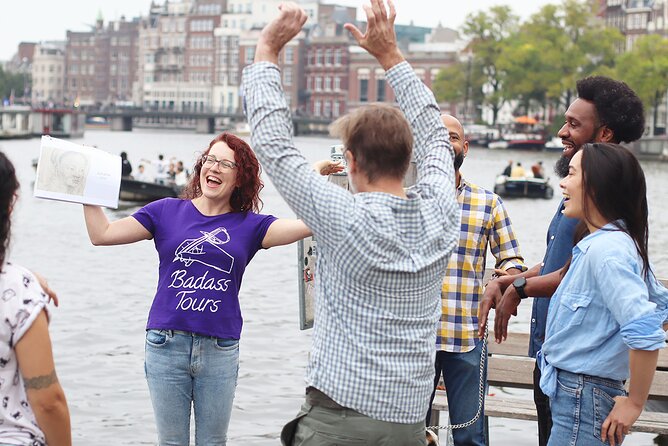
Amsterdam can feel overwhelming fast. There are canals, bridges, museums, and a never-ending parade of statues. This tour is built for that exact moment when you want a handle on the city without committing to a full day.
The format helps. You get around two hours of walking and story beats at distinct stops in the historic center. That means you’re not just hearing about women from the past, you’re also learning where they fit into the city you can still see today. The guiding style is designed to be engaging and inspiring, not academic.
The price is also refreshingly simple: $47.47 per person for about two hours. You’re paying for human storytelling and a tight route through the city, not for museum entries. And the tour notes that the listed stops are admission ticket free, which keeps the experience light on extra costs.
Small-group pace and what it does for your attention

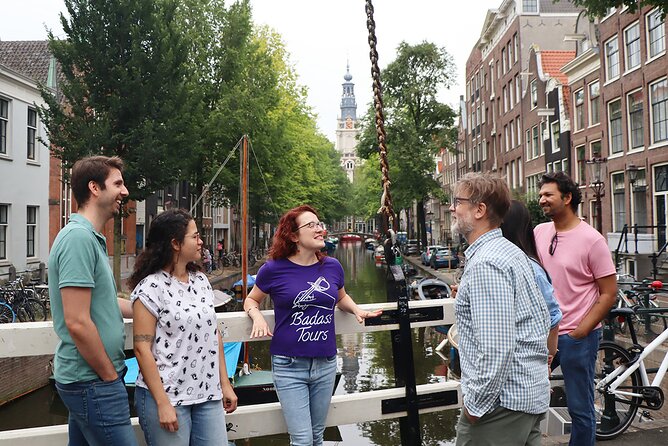
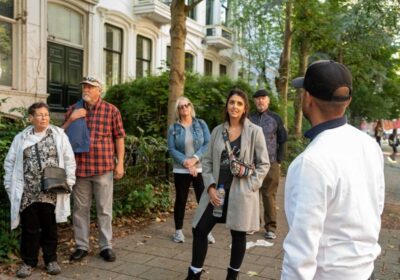
This is capped at 12 people max, and you feel it in how the tour likely moves. Small groups mean the guide can keep momentum without everyone drifting off. It also makes it easier to ask quick questions if something clicks or if a story needs a bit more context.
The tour is led by a trained storyteller, described as an Amsterdam history nerd. That matters because women’s history can get flattened into slogans if the storytelling is generic. Here, the goal is to show how many different kinds of women shaped Amsterdam, from high-level social change to cultural influence, and even spiritual or supernatural defiance.
One practical plus: it’s near public transportation. So if you get turned around on day one, you have an easy way to regroup and return to the route.
Centraal Station start: finding Amsterdam’s “why” in the harbor view
You begin at Prins Hendrikkade 48, 1012 AC Amsterdam. The start point is across the old harbor from Amsterdam Centraal Station, and the tour uses that as your orientation moment.
I like this approach because it turns a major landmark into a starting line for the story, not just a selfie spot. You get an introduction to the city right where it’s practical to understand the geography. It’s also a good time to settle into the tour’s tone, since you’re walking into the historic center with a sense of how the city’s spaces link to the themes you’ll hear about later.
This first stop is short, about 10 minutes, and there’s no added admission component. So you’re not wasting early time waiting for anything to begin.
- Amsterdam Classic Saloon Boat Cruise with Drinks and Cheese★ 5.0 · 31,825 reviews
- Amsterdam Luxury Canal Cruise + Unlimited Drinks & Bites option★ 5.0 · 30,518 reviews
- Amsterdam: Heineken Experience Ticket★ 4.6 · 30,055 reviews
- Amsterdam: Rijksmuseum Entry Ticket★ 4.7 · 25,535 reviews
Beurs van Berlage: women’s stories connected to the stock exchange world
Next comes Beurs van Berlage, with a focus on two female fighters whose stories respond to Amsterdam’s stock exchanges, the new one and the old one now used as an event hall.
This is a smart stop because it challenges the idea that women’s history only lives in domestic spaces. Here, the theme is finance and power, and the way public institutions shape what people can do. I like that the tour doesn’t treat the stock exchange as a dry setting, it treats it as a stage where resistance and ambition can show up.
Expect this to be about 15 minutes, and again the stop is listed with admission ticket free. You’re outside, looking at the architecture, while the guide ties the woman’s story to the space.
Possible drawback at this point: the area is busy. If you’re the type who likes quiet photo moments, you’ll need patience as the guide keeps the group moving.
Dam Square: a fast-hit story when the city feels loud
Then you hit Dam Square. The tour keeps it moving and uses the hustle of the square as part of the storytelling. You’ll hear one of the tour’s more “salacious,” but still tasteful, stories from Amsterdam’s history.
This is where you can tell the tour has a sense of humor and a willingness to humanize the past. Amsterdam’s public spaces have always been where reputations, rules, and entertainment collide. A story delivered while you’re standing in the middle of the action makes that collision feel real.
Time is about 10 minutes at this stop, so it’s not a long pause. It’s a story hit, then you move on.
If you’re sensitive to adult-themed storytelling, know it’s described as salacious but tasteful. That phrasing suggests you won’t get explicit detail, but you also shouldn’t expect everything to be “PG museum voices.”
Beurspoortje: motorcycles, an early gay bar, and Nazis under the table

The Beurspoortje area is one of the most specific, character-driven segments of the tour. The story package here includes motorcycles, Amsterdam’s first modern gay bar, and drinking Nazis under the table.
I like this kind of storytelling because it refuses to treat history like a line of polite achievements. It shows how people navigated danger, identity, and survival. The motorcycles detail signals action, the gay bar detail signals community and culture, and the Nazi reference signals real-world risk. Put together, it explains why Amsterdam could produce stories that feel bold even in hindsight.
This stop is about 10 minutes and again listed with admission ticket free. You’re using the streets as your set.
One practical consideration: because the story contains multiple bold elements, it helps if you’re open to learning through dramatic storytelling. If you prefer strict timelines and only well-documented events, this stop may feel more like a vivid portrait than a slow academic unpacking. Either approach can be valuable, just pick what you like.
Nes and the theater hub: power, money, and a key twist about America
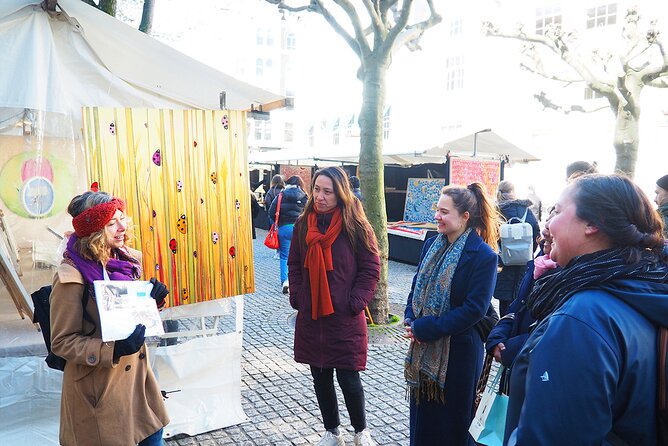
Next you walk through Nes, described as Amsterdam’s hub for cutting-edge theater. The guide connects this stage-like setting to powerful women, including the first Black female millionaire in the Americas. There’s also a hint that she wasn’t in the US.
This is one of the best examples of what the tour is trying to do. It uses a modern-feeling cultural corridor to point back to earlier influence and wealth. Theater areas tend to attract stories about public identity, and that’s a perfect fit for women who pushed against limits.
Time here is about 20 minutes, which is longer than most stops on the walk. That suggests you’ll get more room for context and the story’s “why it matters.” You’re also walking in a zone that’s easy to keep your energy up, since you can see what’s going on around you.
As with any short walking tour, you won’t get every footnote. But the twist about where the millionaire lived is exactly the kind of detail that makes you want to keep learning after the tour ends.
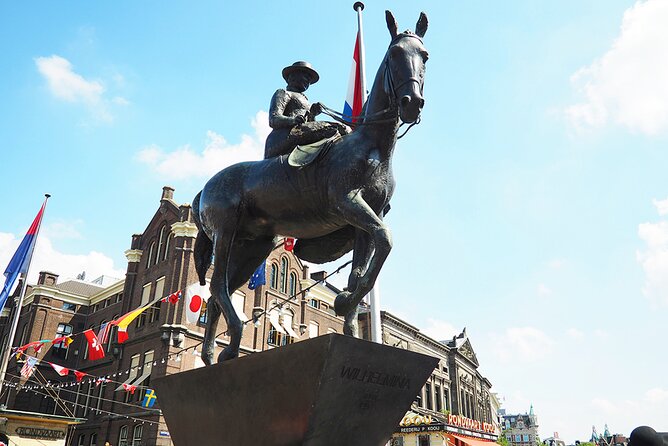
Queen Wilhelmina statue: learning leadership through public presence
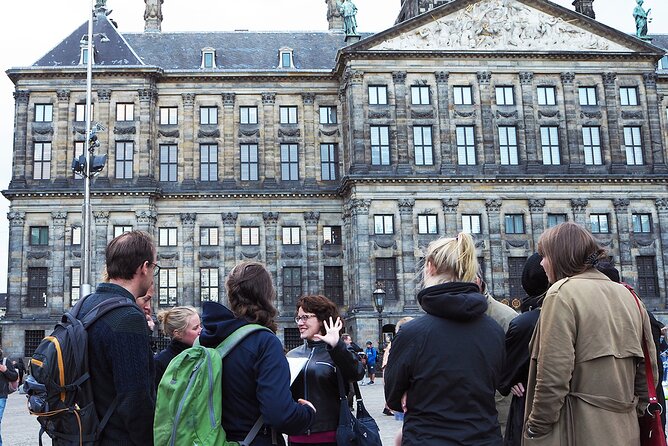
You then move to the equestrian statue of Queen Wilhelmina. Under her confident gaze, the guide explains that she was the Netherlands’ first queen regnant.
This stop works because it flips the script on how statues are usually treated. Instead of reading it as only royal branding, you get to see it as a public statement about power and legitimacy. It also gives you a historical anchor point in the route, so the earlier women-focused stories don’t float in the abstract.
Time is about 10 minutes, admission-free, and it’s outdoors. It’s also a good reset moment between story-heavy stops. You can look, listen, and regroup your legs.
Rokin: canal life, the miracle angle, and how it connects to a women’s riot
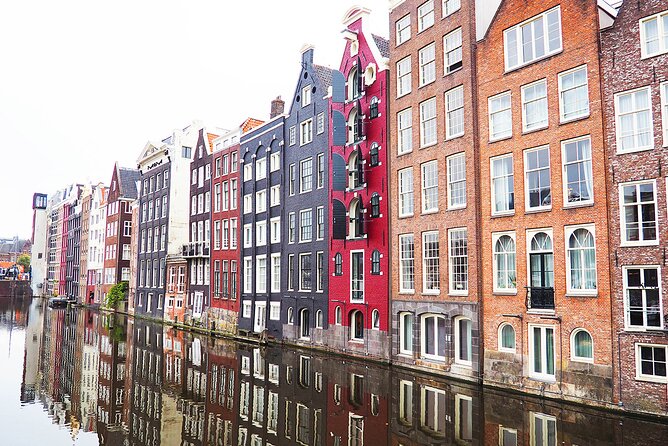
The tour continues along Rokin, Amsterdam’s first main waterway. Here you learn about the Miracle of Amsterdam and how it led to The Women’s Riot.
Canals and women’s history might sound like an odd pairing until you connect the dots between infrastructure, daily life, and social pressure. This stop does that. The idea is that city development shaped people’s lives in concrete ways, and when systems squeezed back, women organized.
Time is about 20 minutes, so it’s not a quick whisper. You get enough explanation to see why the riot happened and why it matters in Amsterdam’s wider story.
If you like photos, this is a great corridor for them. And because it’s tied to a “miracle” framing, it’s also one of those stops that feels like a good story even if you’re not a history person.
Begijnhof finale: a quieter women’s enclave if it’s open
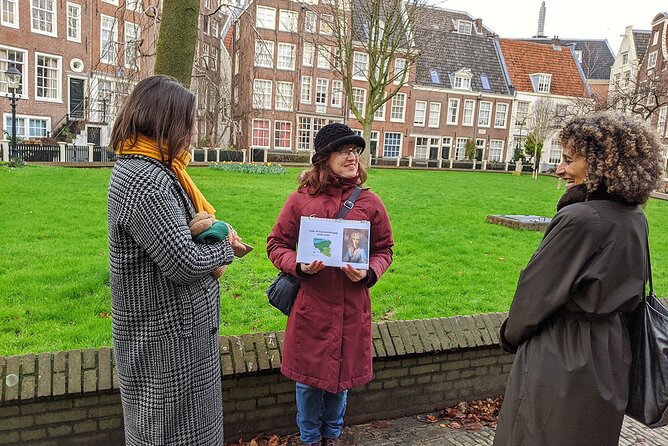
Your final stop is Begijnhof. The tour notes that if you’re lucky, Begijnhof will be open, letting you experience an idyllic women’s enclave in the heart of a noisy city.
This is the emotional payoff. After moving through crowded squares and public architecture, you end in a space meant for women’s community life. Even if it’s not open, ending near it gives you a clear mental picture of how different Amsterdam spaces shaped different experiences.
Time at this stop is about 10 minutes. The tour ends outside the Begijnhof area, and the listed end point is Spui, 1012 Amsterdam. Either way, you finish in a part of town where it’s easy to keep exploring.
Price and tickets: what $47.47 buys you in real terms
Let’s talk value the way you’d want it. $47.47 per person for around two hours isn’t “just a walk.” It’s storytelling plus route design plus a small-group setting.
What makes that value feel fair here is that the stops are listed with admission ticket free. So you’re not getting nickel-and-dimed into museum fees to make up for the price. You’re also not expected to bring extra tickets beyond the mobile ticket.
If you’re doing Amsterdam for the first time, I like tours like this because they help you choose where to go next. Once you’ve heard the women’s stories tied to specific neighborhoods, you can decide whether you want to spend a longer day at a particular site.
So the “cost” is really your time and comfortable shoes, not extra money.
Who should book this women’s history walk
I think this tour is a strong fit if you want:
- Women’s history in Amsterdam’s real streets, not only in big indoor museums
- Storytelling with humor and edge, including salacious but tasteful moments
- A short schedule that works well early in your trip
- A small group experience that keeps the pace lively
It also works well if you like architecture and public spaces and you enjoy learning how social change connects to where people actually live and gather.
If you dislike walking or you want only slow museum-style pacing, this may feel a bit too brisk. And if weather turns, outdoor walking gets harder, since the tour requires good weather.
Weather and comfort: the practical stuff you should plan for
The tour explicitly requires good weather. So I’d treat it like a sunshine-dependent plan. If you’re visiting in a rainy week, keep a flexible mindset, or check the day-of conditions.
Wear shoes that can handle cobblestones and steady walking. Nothing here suggests extreme distance, but it is a walking tour with multiple stops.
Should you book Badass Tours women’s history in Amsterdam?
I’d book it if you want a high-impact way to understand Amsterdam through women’s lives, ambition, and resistance, in about two hours. The small-group size, the guided storyteller approach, and the fact that the route is built around major landmarks makes it efficient and fun. And the $47.47 price feels reasonable when the stops are listed as admission-free and the focus stays on the human stories.
I would skip it only if you need a fully indoor or very quiet experience, or if bad-weather conditions would ruin your schedule.
FAQ
How long is the Small-Group Women’s History Tour in Amsterdam?
The tour is approximately 2 hours.
What is the group size limit?
This experience has a maximum of 12 travelers.
Where does the tour start?
The meeting point is Prins Hendrikkade 48, 1012 AC Amsterdam, Netherlands.
Where does the tour end?
The tour ends outside the Begijnhof area. The listed end point is Spui, 1012 Amsterdam.
Do I need a paper ticket?
No. You receive a mobile ticket.
Are there admission tickets required for the stops?
The tour information lists admission as free for the stops on the route.
Is the tour suitable for most people?
The information says most travelers can participate.
Can I bring a service animal?
Yes, service animals are allowed.
What happens if the weather is bad?
The experience requires good weather. If it is canceled due to poor weather, you will be offered a different date or a full refund.
Is there a cancellation and refund window?
Free cancellation is available. You can cancel up to 24 hours in advance for a full refund, based on local time. If you cancel less than 24 hours before the start time, the amount paid will not be refunded.
The Older City, Told Properly






More Tours in Amsterdam






More Tour Reviews in Amsterdam





Newly reviewed around Amsterdam





Historical Tours, side by side.
 ★ 5.0Amsterdam Food and Cultural Tour with TastingsFrom $912,442 reviews
 ★ 4.5Haunted History and Ghost Walking TourFrom $30488 reviews
 ★ 5.0Amsterdam High-End Dutch Food & History Tour – Up to 8 guestsFrom $157482 reviews
 ★ 4.5Historic City Sightseeing Canal CruiseFrom $18444 reviews
 ★ 4.6Historical Highlights Walking Tour with TastingFrom $34381 reviews
 ★ 5.0Anne Frank and the Jewish History of Amsterdam Private TourFrom $95307 reviews
 ★ 4.53-Course Meal in Historic 1st Class Waiting RoomsFrom $61292 reviews
 ★ 4.8Highlights & History Walking TourFrom $32266 reviews
More ways to plan this visit