

REVIEW · ANNE FRANK & JEWISH QUARTER TOURS
Anne Frank’s Story – Guided Walking Tour through Amsterdam
This walk hits you with context fast. In about two hours, you get a WWII-focused route through Amsterdam’s Jewish Quarter, ending by the Anne Frank House area. I especially like the small-group feel, so the guide can actually answer questions as you go.
The tour’s second strength is the way it uses real street-level landmarks to explain what life changed for Jewish and non-Jewish residents under Nazi occupation. My only heads-up is the big one: the Anne Frank House interior is not included, so you will not go inside during this tour.
Key points worth knowing before you go
- Small group, up to 15 people, which keeps the pace human and the stories clear.
- Outside-only viewing of major sites like the Jewish Historical Museum and the Portuguese Synagogue.
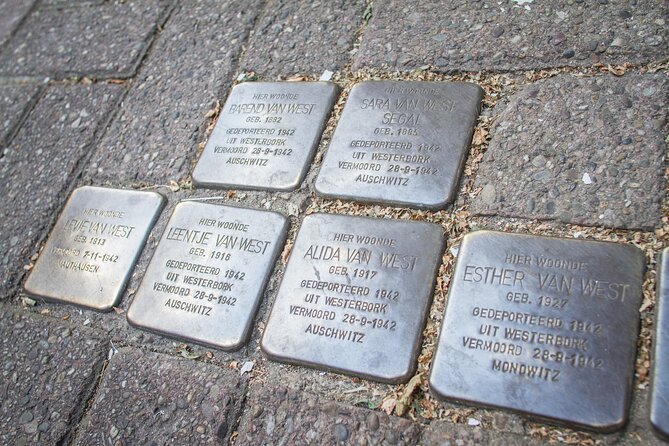
- Memorial stops that shift the tone from learning to remembering, including Auschwitz Monument.
- Period details and names like the Winter of Hunger and the February Strike to make WWII less abstract.
- Great option if Anne Frank House tickets are sold out, since you still end right at the site.
More careful routes through Amsterdam’s Jewish history

A focused 2-hour Jewish Quarter walk that stays on track
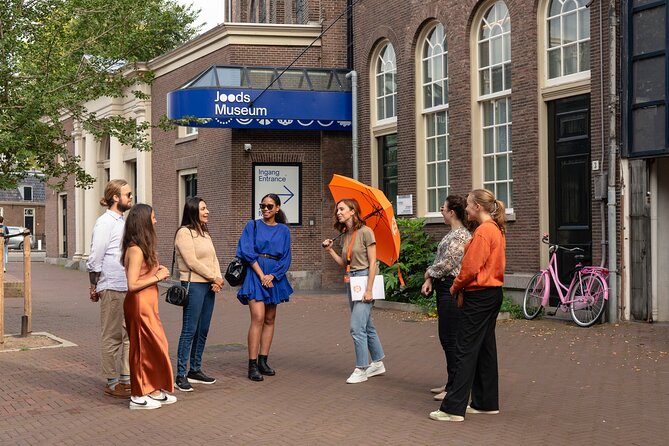
This is a guided walking tour in central Amsterdam with a duration of about 2 hours. The group size stays at a maximum of 15, which matters more than you might think. When the subject is heavy, you want fewer voices competing and more time for questions.
You meet near the Anne Frank House area at Westermarkt 20, 1016 GV Amsterdam. You should arrive about 15 minutes early so you start on time. Wear comfortable shoes, because you are on your feet for multiple stops, and Amsterdam streets can be uneven in spots.
The tour is offered in English, and you get a mobile ticket. Service animals are welcome too. If you have a moderate physical fitness level, this should feel manageable, but check the day’s weather and dress for it, because walking tours live and die by conditions.
One nice practical bonus: some guides add local tips along the way. In the feedback I reviewed, people mentioned extra helpful moments like bike lane etiquette, which can make your rest of the trip feel smoother.
Joods Museum and the Portuguese Synagogue, from the sidewalk
The tour begins with a look at the Jewish Historical Museum area, timed for a quick stop to get your bearings. You do not enter the museum. Instead, the guide talks from the outside and uses the location to set the stage for Jewish Amsterdam.
A short hop later, you spend time outside the Portuguese Synagogue. Again, you do not go inside. But you still get context for why these buildings matter and how they connect to community life. Even without entering, these stops help you understand the geography of the Jewish Quarter, so when the route turns toward WWII memorials, it feels grounded rather than floating.
Here’s the practical benefit for your planning: if you are doing multiple museums on a trip with limited time, this tour gives you cultural and historical framing without forcing extra ticket lines right away. The trade-off is obvious, and it’s fair: if your dream is to step inside these specific buildings, you will need separate plans.
WWII Amsterdam through specific streets and Jewish-community landmarks
After the opening stops, the tour shifts into the Nazi occupation years, 1940 to 1945, and how it affected not only Jewish residents but day-to-day life across Amsterdam. The big win here is that the guide connects the story to places you can actually point at.
You pass the head office of the Jewish council, and you learn about key events like the Winter of Hunger and the February Strike. These names do a lot of work. They take the war out of vague dates and turn it into lived events, with cause-and-effect you can remember.
This part also tends to include period photos. In the feedback I saw, people appreciated guides using images from the time to link past and present. That kind of visual anchor can make the route feel more immediate, without turning it into spectacle.
If you care about accuracy and context, this is where the tour can feel most satisfying. Instead of a general overview, you get the sense of a city changing under pressure, and you see how ordinary routines collided with persecution.
Amsterdam at street level, a few more routes
- Anne Frank’s Story – Guided Walking Tour through Amsterdam★ 5.0 · 11,619 reviews
- Amsterdam: Life of Anne Frank and World War II Walking Tour★ 4.8 · 10,467 reviews
- Absolutely Amsterdam – the Essential Introductory Walking Tour★ 5.0 · 3,629 reviews
- Amsterdam: Anne Frank Guided Small Group Walking Tour★ 4.8 · 2,722 reviews
Dokwerker and Auschwitz Monument, where the route gets emotionally heavier
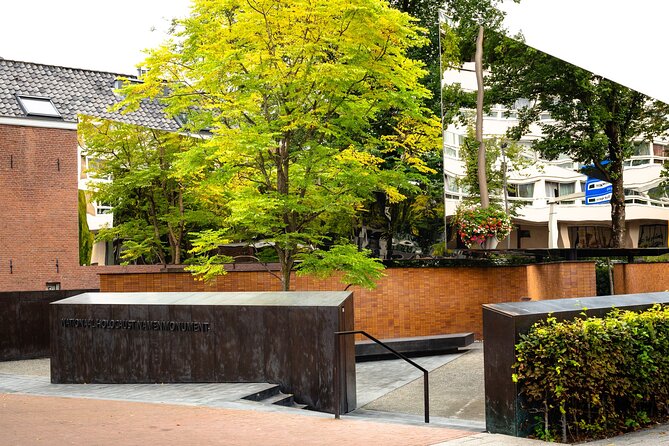
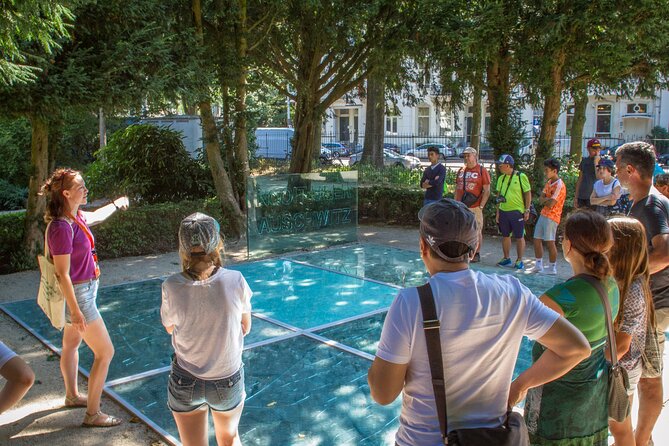
The stops at the memorials are where the tour changes gear. You spend time at the Dokwerker statue and then the Auschwitz Monument. Both are part of why this walk works for WWII history buffs.
At the Dokwerker statue, you get a connection to the work and the people of the era, not just the camps and dates. It’s a reminder that history involved real labor, real streets, and real communities.
Then comes the Auschwitz Monument, where the focus turns sharply to remembrance. In the reviews, people highlighted small, respectful moments around the memorial, like placing a rock near a name. That detail matters because it gives you a way to participate in the act of honoring without turning the visit into a checklist.
A practical note: memorial stops can be quieter and more reflective. If you tend to lose focus in heavy settings, plan to slow down here. Give yourself those extra minutes. The guide will likely keep talking, but you will also want a second to look, read, and absorb.
Dam Square and the Anne Frank statue, connecting the story to public Amsterdam

You then move into more central, open-space landmarks. You stop at Dam Square and the National Monument of Amsterdam, which helps widen the lens. Instead of only thinking of the Jewish Quarter as a separate world, you see that the story played out in the broader city.
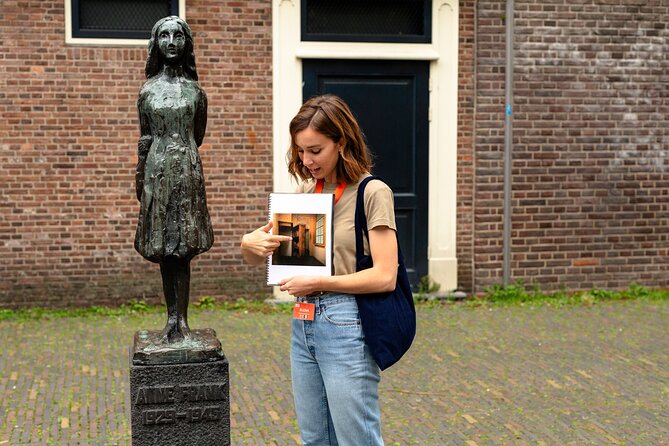
Next is the Statue of Anne Frank. This is a reminder that her name became a symbol, but symbols come from specific places, specific years, and specific people. Seeing the statue after you’ve heard the occupation context can help you understand why her story mattered in the first place, and why it became enduring.
If you like tours that connect personal narrative to public memory, this section is a strong pivot. You move from memorial space to civic space, then back toward the Anne Frank House area.
Ending outside the Anne Frank House, how to handle the not-entering reality
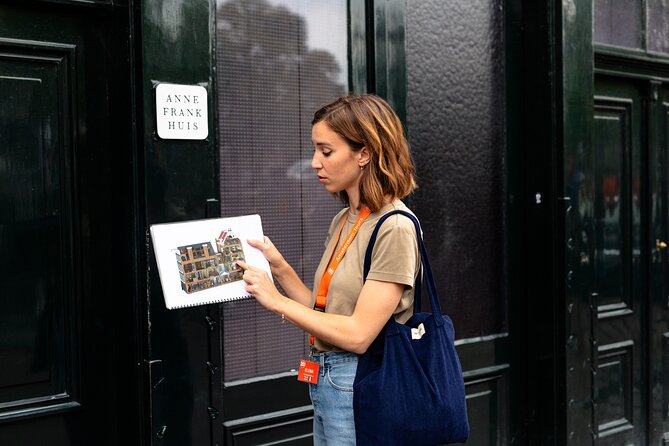
This tour ends right outside the Anne Frank House, with a final stop time around 15 minutes. The important detail is that this tour does not include entrance to the Anne Frank House. You will not go inside during the walk.
Why does that still work? Because you are not just arriving at a famous address. You get the surrounding story first, so when you reach the end point, the location feels earned. You hear how Anne Frank’s diaries were published by her father, Otto Frank, and you connect her story to the city route you just walked.
The drawback is also clear, and you should plan for it: if the goal is to enter the house itself, you need to do that separately. Some people get surprised by this, especially if they are hoping the walk includes museum access. If you know your priorities, you can avoid that frustration.
My practical approach if you want both: book your Anne Frank House entry separately for a day where you still have energy for a walk afterward. Then use this tour as the context builder. If tickets for the house are not available, this walking tour becomes a meaningful alternative, because you still finish at the exact spot where the story lives in physical form.
Price and value: what you’re really paying for at $39.30
At about $39.30 per person for roughly 2 hours, the value question is simple: you are paying for a guided, small-group route plus a tight historical narrative delivered on foot. Admission to the Anne Frank House is not included, and tickets for the Jewish Historical Museum and the Portuguese Synagogue are also not included.
So who gets the best value?
- If you want a guided story you can remember, and you do not mind outside viewing.
- If you want memorial context tied to streets, not just museum walls.
- If you are okay treating the Anne Frank House as an end point where you learn, then enter separately if you can.
Who should think twice?
- If your only goal is entry into the Anne Frank House and you are not willing to book that separately.
- If you hate “outside only” stops and assume every famous sight means you go through a door.
The reason this tour can still feel worth it, even without museum entry, is pacing. You get a single thread through multiple key locations in one go. Instead of stitching together several stops on your own, you get a guide to connect them, including events like the Winter of Hunger and the February Strike, and the role of Dutch resistance in offering secret hiding places for families like the Franks.
The guides, and why small-group delivery matters here
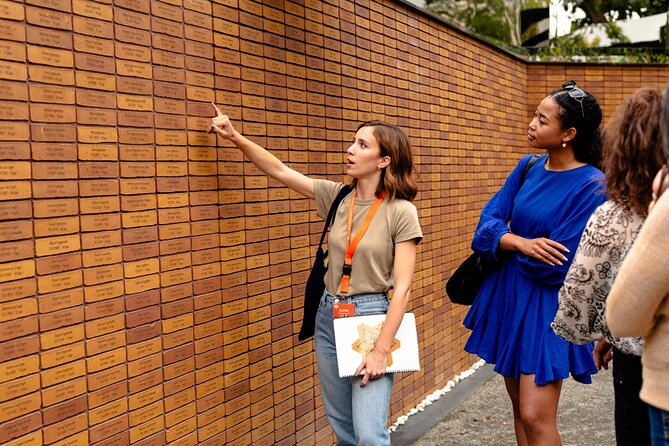
This tour depends a lot on the guide. The good news is that the route is designed for storytelling, and the feedback I saw repeatedly praised guides who could balance respect with clarity.
Names that came up include Yoshi, Ollie, Giovanni, Manuel, Patrick, and Edwin. People described them as engaging, thoughtful, and able to keep the pace moving while still handling difficult material with the right gravity. In at least one case, a guide also made extra time for photos so everyone could see. That kind of small-group attention is not just pleasant, it helps you follow the story in the moment.
If you learn best by listening, a guided route like this is a strong match. If you prefer total independence, you might still enjoy it, but you will want to study the sites yourself afterward.
Who this tour suits best in your Amsterdam plan
This is a great fit if you are:
- A WWII history buff who wants Amsterdam connected to the occupation and its consequences.
- Visiting Amsterdam for a short time and want a concentrated, walking-friendly route.
- Someone who prefers small-group tours over large crowds.
It also works well for families, including kids, as long as the group is ready for serious themes. One review mentioned it as a meaningful option for families, with guides staying respectful and organized.
What to watch for: if you are emotionally sensitive, the memorial stops can be intense. You do not need to tough it out. You can take a break, step back, and let the tour continue at a slower pace. The structure gives you a natural rhythm.
Should you book Anne Frank’s Story walking tour?
I think you should book it if your goal is to understand how Anne Frank’s story fits into the actual geography of Jewish Amsterdam and Nazi-occupied life. The route does a lot with two hours, and the small-group size helps the message land.
Book it with two clear expectations:
1) You will see key sites from the outside, including the Jewish Historical Museum area and the Portuguese Synagogue.
2) You will end at the Anne Frank House, but you will not enter it.
If you can line up Anne Frank House entry separately, this tour becomes a powerful warm-up. If you cannot get tickets, it can still be a meaningful way to experience the surrounding story and memorial context without spending your whole day waiting in lines.
FAQ
What is the duration of Anne Frank’s Story guided walking tour?
It is about 2 hours.
How much does the tour cost?
The price is $39.30 per person.
Is it a small-group tour?
Yes. It has a maximum of 15 travelers.
What language is the tour offered in?
The tour is offered in English.
Do I get a mobile ticket?
Yes, the tour includes a mobile ticket.
Does the tour include entrance to the Anne Frank House?
No. The tour ends outside the Anne Frank House, and entrance is not included.
Are tickets to the Jewish Historical Museum and Portuguese Synagogue included?
No. Entrance to both of those is excluded, and you would need separate tickets if you want to visit them.
Which stops are included on the walk?
The walk includes stops outside the Jewish Historical Museum area, the Portuguese Synagogue, the Dokwerker statue, the Auschwitz Monument, Dam Square, the Statue of Anne Frank, and it ends outside the Anne Frank House.
Can children join the tour?
Children must be accompanied by an adult.
What happens if it’s canceled due to poor weather?
The experience requires good weather. If canceled due to poor weather, you will be offered a different date or a full refund.
Are service animals allowed?
Yes, service animals are allowed.
More Tours in Amsterdam






More Tour Reviews in Amsterdam






Continue through the Jewish Quarter





Newly reviewed around Amsterdam




Anne Frank & Jewish Quarter Tours, side by side.
 ★ 4.8Life of Anne Frank and World War II Walking TourFrom $3710,467 reviews
 ★ 4.8Anne Frank Guided Small Group Walking TourFrom $282,722 reviews
 ★ 4.9Anne Frank Walking Tour – Guided in EN/DE/IT/ESFrom $282,676 reviews
 ★ 5.0Anne Frank Walking Tour Amsterdam Including Jewish Cultural QuarterFrom $751,879 reviews
 ★ 5.0Anne Frank’s Last Walk & See Anne Frank House in Virtual RealityFrom $42957 reviews
 ★ 4.7Dutch WWII Resistance Museum Entry TicketFrom $21951 reviews
 ★ 5.0Anne Frank and Jewish Quarter Amsterdam Private Walking TourFrom $157684 reviews
 ★ 4.3Canal Cruise from Anne Frank MuseumFrom $18563 reviews
More ways to plan this visit