
REVIEW · WALKING TOURS
Walking Tour about Golden Age Architecture, private local guide
Amsterdam has a way of rewarding slow looking. This private 1 hour 30 minute walk connects the city’s famous canals to the Golden Age architecture that made Amsterdam rich, powerful, and oddly creative. I love how you get a private local guide pace, so you can ask questions as you go. I also love the focus on specific building clues, like gevelstenen facade stones, that make the streets feel readable. One possible drawback, it is still a walking tour, and it is not recommended if you use a walker or struggle standing for 1.5 hours.
You will start at the Royal Palace area and finish near the Westerkerk, close to the Anne Frank House area. The tour runs in English, uses a mobile ticket, and the stops listed are admission-free, so you spend your time watching and listening instead of budgeting museum entry fees.
With a price of $73.59 per person, this works best when you want a concentrated, high-impact orientation to Amsterdam’s architecture in one go. If you want a lot of long indoor time, you might feel a little constrained by the street-level format.
Key reasons this tour is worth your time
- Private guide, one-on-one style attention to architectural details other tours rush past
- Golden Age design explained with engineering context, especially building on challenging ground
- Canal-belt symbols you can recognize, like wealth emblems tied to maritime trade
- Facade stone spotting in Jordaan (gevelstenen), turning building fronts into storyboards
- A smart ending near Westerkerk, easy to connect to nearby sights on your own
Amsterdam at street level, a few more routes
Golden Age Architecture On A Private 90-Minute Walk
This is the kind of tour that helps your eyes catch up with your brain. Amsterdam is full of pretty buildings, sure. But this walk is about why those buildings look the way they do, and what that design says about trade, wealth, religion, and even construction math.
You are not just collecting names. You are learning how Amsterdam’s 17th century boom shaped the city’s look, block by block. The pace is designed for a single focused session, about 1 hour 30 minutes, so you can keep the rest of your day for wandering, coffee, or a museum you actually care about.
The value is also practical. The tour is private, offered in English, and the listed stops have free admission. That matters because it reduces the usual tourist math, time lost to lines, and the surprise costs that can creep into a “simple” walk.
Also, plan for outdoor time and uneven city footing. The tour is not described as having mobility aids, so bring realistic expectations if you have limited walking tolerance.
Dam Square To The Royal Palace: Power, Trade, And Clay Foundations
Dam Square, where Amsterdam’s rise gets framed
You start at Dam Square, with an introduction to Amsterdam’s history and why this place mattered. The tour sets up the Dutch Golden Age as the turning point: Amsterdam grows into a global trade hub in the 17th century, and that prosperity directly influences what gets built and how it gets built.
This opening is useful even if you have been to Dam Square before. It gives you a lens. Instead of seeing the square as a generic central spot, you start thinking about wealth, shipping, and civic ambition. That mindset carries you through the rest of the walk.
Worth comparing with this Amsterdam choice:
- Amsterdam: 75 Minute City Canal Cruise with Audio Guide★ 4.4 · 17,501 reviews
- Anne Frank’s Story – Guided Walking Tour through Amsterdam★ 5.0 · 11,619 reviews
- Amsterdam: Johan Cruijff ArenA Tour with Optional Guide★ 4.6 · 8,954 reviews
- Amsterdam: Royal Palace Entry Ticket and Audio Guide★ 4.6 · 6,475 reviews
Royal Palace Amsterdam, a town hall turned royal stage
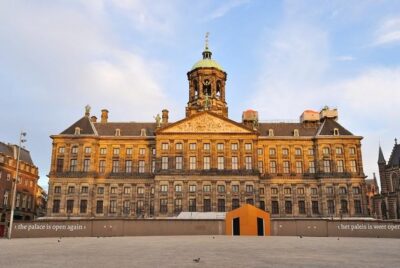
Next comes the Royal Palace Amsterdam. Here the tour focuses on a key transformation: the building was originally constructed as the city’s town hall during the Dutch Golden Age, then later became the royal residence it is today.
What I like about this stop is the blend of style and survival. You get the Dutch Neoclassical look as part of the story, plus how the builders handled materials and techniques. And then you get the part people often skip, the engineering reality of building on clay and marshy ground. Amsterdam did not win by building like other cities. It won by building anyway, on land that fought back.
If you enjoy architecture that has “how did they do that?” energy, this is a great place to slow down and look at the overall massing and structure without needing museum entry tickets.
Canal Belt Details You’ll Actually Notice: Huis Bartolotti And Torensluis
Huis Bartolotti, baroque luxury along the canal
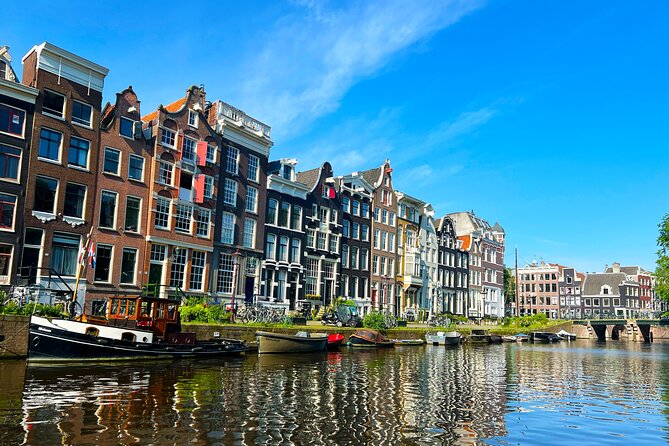
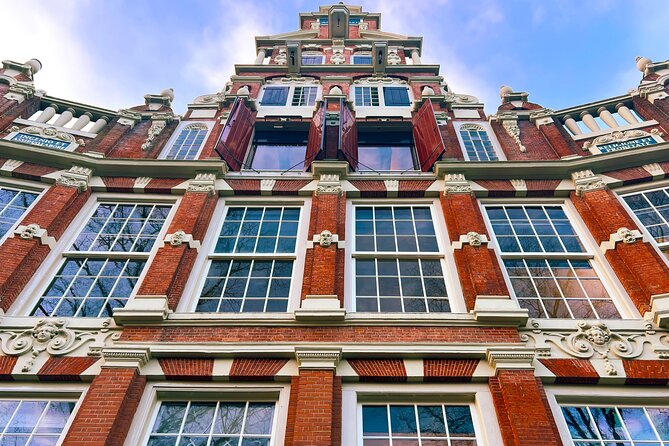
Huis Bartolotti is described as a 17th-century Dutch baroque house on a scenic canal. The details you get to watch for are specific: striking red brick, large windows, and sculptural elements in sandstone.
Then the tour adds the human reason behind the beauty. The ornate facade reflects wealth and status, and it also points to trading ties with Italy. When a guide connects decoration to trade links, the building stops being decorative and starts being informative.
Photo tip that you can use right away: with canal-side facades, angles matter. If you take photos, try a couple positions, one closer to eye level and one where you can include the canal alignment. You will usually see more of the facade stones and sculptural edges that way.
Torensluis, mercantile facades and crooked-house resilience
Torensluis is a wide bridge with excellent viewing. The tour highlights four unique facade designs popular with the mercantile class during the Golden Age. You also learn how Baroque style got adapted in the Netherlands, with intricate details and dramatic contrasts.
Then comes the Amsterdam twist: “crooked houses.” The guide explains them as a result of the city’s soft, marshy ground. The takeaway is smart, you are not looking at mistakes. You are looking at architecture that had to respond to real ground conditions.
This stop is especially good if you like architectural variety. Instead of one building style, you see variations tied to class and era. And because it is on a bridge, you can take in multiple facades without weaving through too many streets.
Wealth Symbols And Merchant Names: De Dolphijn’s Story
De Dolphijn is a canal house with a name that points straight at status. The dolphin symbol is tied to wealth, and the tour connects that to Amsterdam’s maritime trade during the Dutch Golden Age.
Then you get a link that makes the story feel bigger than one facade: it was originally owned by Frans Banning Cocq, the captain immortalized in Rembrandt’s The Night Watch.
This stop works because it turns a small architectural landmark into a cultural one. You are seeing how Amsterdam’s merchant identity shows up in house names, symbols, and ownership history. Even if you do not go deep into art museums, that kind of cross-connection helps the city click.
If you are the type who likes to notice signs of trade everywhere, this is a satisfying moment.
Domes And Spires: From Ronde Lutherse Kerk To Westerkerk
Ronde Lutherse Kerk, a Renaissance design marker
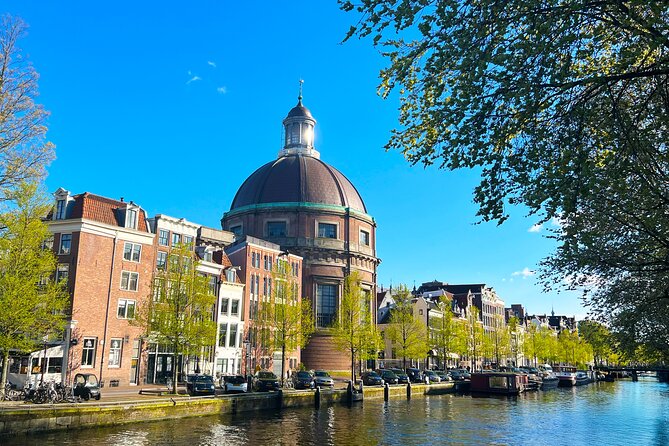
Ronde Lutherse Kerk gets a short stop, and the focus is on domes as a high point of architectural achievement in the Renaissance period. You might not get a long inside-the-building segment here, but you do get a conceptual tool: domes are not just decorative. They represent a shift in engineering ambition and design priorities.
If domes are your thing, this quick visit can still help you spot them later around Amsterdam and understand what you are looking at.
Westerkerk, Calvinist simplicity and a 85-meter clock tower
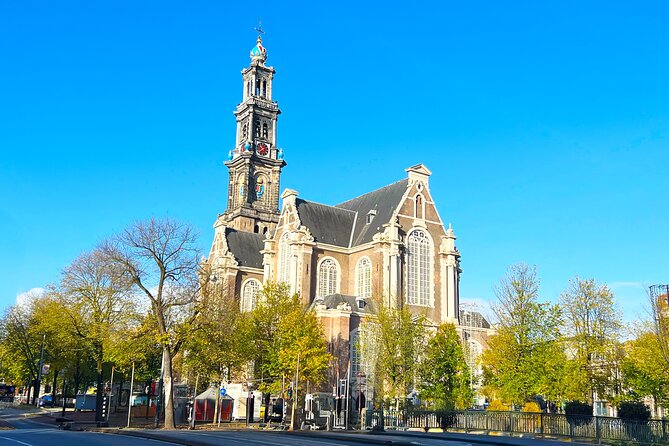
Westerkerk is one of the most important landmarks on the route. The tour explains it as a Calvinist church built to serve a growing city population. You hear what Calvinist worship spaces tended to emphasize: a large, airy interior and a simple, elegant design.
You also get the historical layer. Westerkerk is the final resting place of Rembrandt van Rijn. And the spire, completed in 1638, rises 85 meters above the Jordaan district, crowned with the imperial crown, a symbol of Amsterdam’s status since the 15th century.
There is even a specific note tied to timekeeping. The tower’s clock chimes are described in Anne Frank’s diary. That detail is small, but it is the kind of thing that makes you feel connected to the building beyond architecture.
For most visitors, this is the stop that leaves the strongest “wow, that is part of Amsterdam” feeling because it combines skyline scale with personal cultural references.
Prinsengracht Warehouses: The Hoisting-Beam Practical Side Of Prestige
Prinsengracht comes next, and this is where the tour gets very hands-on in its thinking, even though you are just walking.
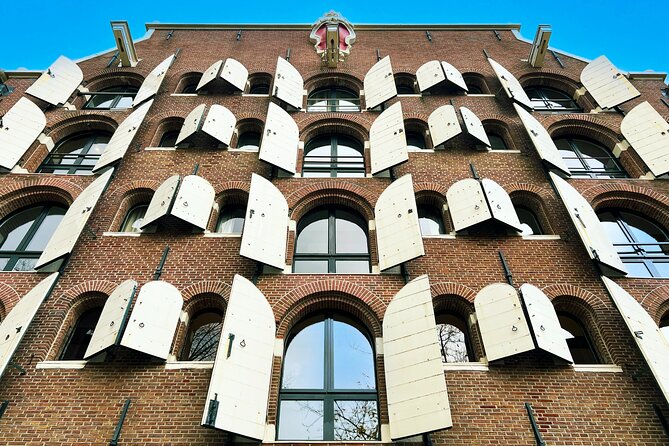
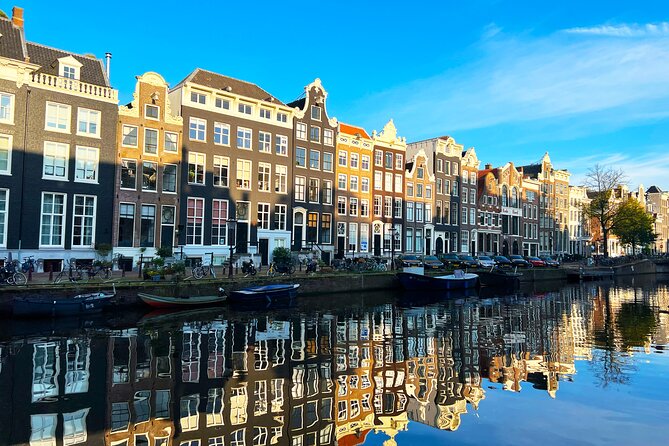
The guide explains the warehouses along Prinsengracht as iconic examples of Golden Age trade architecture. The features are functional, tall steeply pitched gables, large windows, and wooden hoisting beams on the roof used to lift heavy cargo from ships docked along the canal.
This is one of the most valuable parts of the tour because it teaches you to read architecture as a tool. The exteriors may look simple, with clean lines and minimal ornamentation. But that restraint makes sense when you remember the buildings were designed to work. Still, the grand scale signals merchant power and wealth.
If you want a quick way to make sense of Amsterdam’s canal belt, focus on the roofline and the hoisting beam idea. Once you picture it, the buildings stop being static and start being practical machines for trade.
Jordaan Facade Stones And The Neighborhood Map You Can Reuse
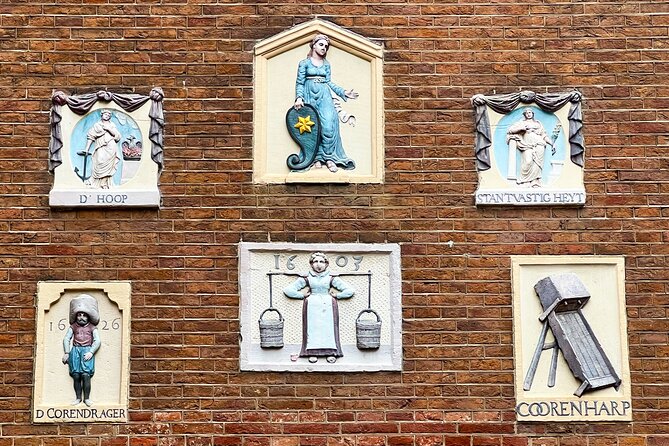
The Jordaan stop shifts from big buildings to small details that most people walk past without noticing.
The tour describes Jordaan in the 17th century as a mix of residential and commercial life. It starts as a lower- and middle-class area for craftsmen and laborers. Then it grows into a hub with narrow canals, tight rows of houses, and small shops or workshops at street level.
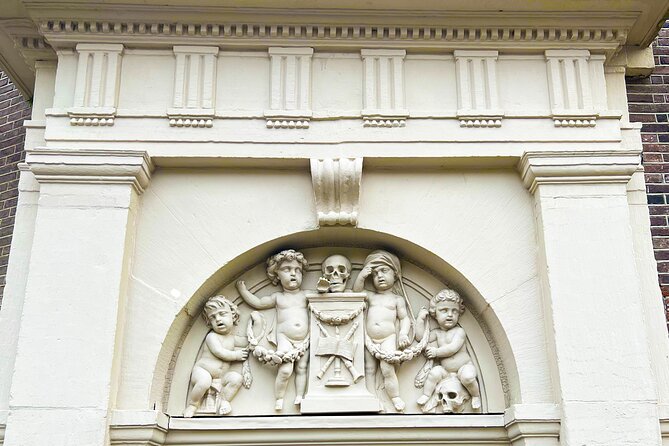
Then you do something smart: you focus on gevelstenen, facade stones. These are small decorative plaques embedded in building facades. The tour explains they can communicate what the building was used for, the profession of the owner, or other significant facts about the people living and working there. Many have intricate carvings.
This is where the tour becomes more than a set of stops. It gives you a skill you can use afterward. When you are wandering the canal belt on your own, you will start spotting facade stones and reading the street like a map.
The time spent here also makes the earlier stops click. Once you see how owners sign their presence in stone and symbol, you understand why so many canal buildings feel like statements, not just shelter.
Price And Logistics: What You Get For $73.59
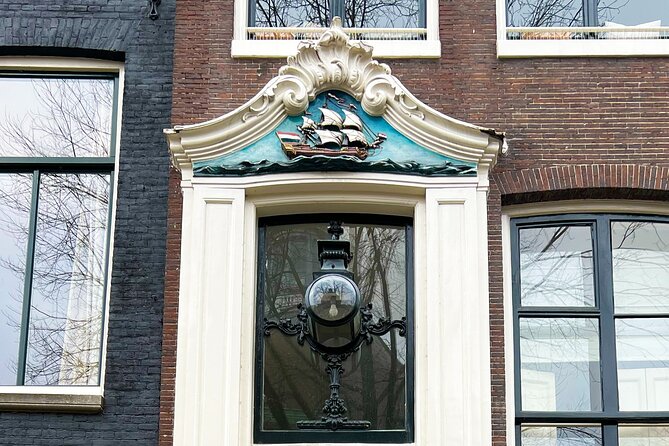
At $73.59 per person for about 1 hour 30 minutes, this is not a budget group deal. It is priced for what you are actually paying for, a private guide attention span and a carefully chosen route that hits major Golden Age architecture moments in one session.
Several details improve the value:
- The tour is private, so it stays focused on your group.
- It runs in English.
- The listed sites are free to access, so you are not paying entry fees across the route.
- You get a route that connects civic power, merchant wealth, trade infrastructure, and neighborhood storytelling.
A small note that can affect your experience: bottled water is not included. Amsterdam walks can add up fast in warm or windy weather, so I would bring water or grab it before you start.
Also keep expectations realistic on mobility. The tour is not recommended if you use a walker or if you have trouble walking and standing for 1.5 hours. Mobility aids are not available for the tour.
Should You Book This Golden Age Architecture Walk?
Book it if you want a short, high-impact architecture orientation that teaches you how to see the city. This tour is especially good for you if:
- You like architecture and want more than surface descriptions.
- You enjoy canals, but want to understand the trade logic behind the buildings.
- You want to spot details like gevelstenen and learn what they can tell you.
- You prefer private, question-friendly pacing.
Skip it or consider an alternative if:
- You have limited ability to walk or stand for 1.5 hours.
- You need lots of indoor time or guided access that is not described here.
- You are not interested in building details and want mostly general sightseeing.
If you are balancing a tight Amsterdam schedule, this is the kind of tour that can pay off the rest of your trip, because you leave with a way of looking.
FAQ
How long is the walking tour?
The tour lasts about 1 hour 30 minutes.
Is this a private tour?
Yes. It is private, and only your group participates.
What language is the tour offered in?
The tour is offered in English.
Where does the tour start and end?
It starts at Royal Palace Amsterdam, Nieuwezijds Voorburgwal 147, 1012 RJ Amsterdam, Netherlands. It ends near Westerkerk, Prinsengracht 279, 1016 DL Amsterdam, Netherlands.
Are there admission tickets you need to pay for the stops?
The stops listed are marked as admission ticket free.
Is bottled water included?
No. Bottled water is not included.
Is this tour suitable if I use a walker or have trouble walking?
It is not recommended for participants who use a walker, or for participants who have trouble walking and standing for 1.5 hours.
Are mobility aids available during the tour?
No. Mobility aids are not available.
Are service animals allowed?
Yes, service animals are allowed.
What is the cancellation policy?
You can cancel for free up to 24 hours before the experience for a full refund. If you cancel less than 24 hours before, the amount paid is not refunded.
Amsterdam on Foot




More Tours in Amsterdam




More Tour Reviews in Amsterdam


Newly reviewed around Amsterdam



Walking Tours, side by side.
 ★ 5.0Anne Frank’s Story – Guided Walking Tour through AmsterdamFrom $3911,619 reviews
 ★ 4.8Life of Anne Frank and World War II Walking TourFrom $3710,467 reviews
 ★ 5.0Absolutely Amsterdam – the Essential Introductory Walking TourFrom $53,629 reviews
 ★ 4.8Anne Frank Guided Small Group Walking TourFrom $282,722 reviews
 ★ 4.9Anne Frank Walking Tour – Guided in EN/DE/IT/ESFrom $282,676 reviews
 ★ 4.9Guided Cultural Walking TourFrom $292,384 reviews
 ★ 4.2Guided Ganja Walking Tour of Coffee ShopsFrom $272,092 reviews
 ★ 5.0Anne Frank Walking Tour Amsterdam Including Jewish Cultural QuarterFrom $751,879 reviews
More ways to plan this visit