
REVIEW · WALKING TOURS
Amsterdam private city walking experience with a local
Seven stops, one clear Amsterdam story. This 2 hour private city walk weaves big-picture history into real streets, from Beursplein’s trade-era roots to the calm hush of Begijnhof, ending at the architectural showstopper of Centraal Station. It is guided in English, for groups up to 12, so you get a thoughtful route without the shuffle.
I especially like how the guide uses the city itself as the lesson plan. You will connect names, places, and eras, like how Beursplein ties back to Amsterdam’s origins and how Dam Square links the Royal Palace to WWII memory. I also like the personal feel, with a guide who can answer questions and adjust the walk to what you care about, whether that is architecture or local life.
One thing to consider is the pacing. This is a walking-focused experience, so if your feet need lots of breaks, you may want to plan for short rest stops and choose footwear accordingly.
Key highlights worth knowing
- A private route for up to 12 people so the conversation stays on your group
- Seven landmark stops in about 2 to 2.5 hours with time to pause and ask questions
- Local context at every site linking trade, religion, guild power, and modern neighborhoods
- Begijnhof and the tolerance angle plus sights like the oldest-style homes and wooden cottages
- A strong finish at Centraal Station with its role as both hub and symbol
- Manouk’s style, maps, and practical tips that help you keep exploring after the tour
Amsterdam at street level, a few more routes
Starting at Beursplein, where Amsterdam’s name and power begin
Beursplein is a smart first stop because it sets the theme fast: Amsterdam grew from something small into a serious player in European trade. Here, you learn where the city’s name comes from and how a fishing village evolved into the center of global commerce in the 17th century. Instead of treating history like a museum script, the guide ties it to what you can still feel in the area today.
I like that this start gives you a framework. When later you see grand buildings and political spaces, you understand the engine behind them. You will also be in a practical spot to begin your walk, and the tour keeps the pace light at each stop, about 15 minutes here.
Possible drawback: if you are expecting lots of indoor time or formal exhibits, this tour is more about storytelling in the open. You are outside most of the way, so dress for the weather.
Dam Square and the Royal Palace, power in plain view
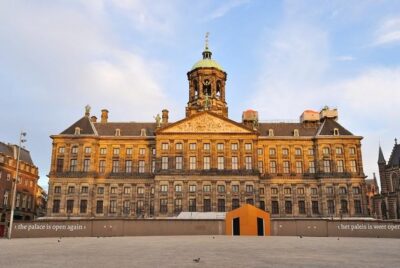
Dam Square is the postcard center of Amsterdam, but this walk treats it like a living political stage. You will hear what Dam Square meant in the city’s formation and why it became such a key civic anchor. Then you look at the Royal Palace on the Dam, not as a pretty facade, but as a symbol of state authority and public life.
The second layer that I find useful is WWII context. Amsterdam’s major public spaces are where history leaves traces you can still read, and Dam Square is one of them. The guide connects those dots so the palace and the square do not feel like random sights you tick off.
Time check: the stop runs about 15 minutes. It is long enough to take photos and absorb the story, but short enough that you keep momentum across the next neighborhoods.
Begijnhof, a quiet courtyard lesson in Amsterdam’s tolerance
Begijnhof is a different kind of Amsterdam moment. After busy central streets, you enter a calm courtyard feel, the kind of place where people slow down without being told. The guide explains the religious history of this enclosed space and what it reveals about Amsterdam’s tolerance, not in theory, but in how the place is set up and used.
You also get concrete sights that make the story easier to remember. You will see one of the oldest houses in Amsterdam, plus two wooden cottages. That combination, religious history plus unusual old buildings, turns Begijnhof into more than a pretty stop. It becomes evidence you can look at while the guide explains the broader social idea.
What I like: this is the stop where the tour feels most like a local secret, even though it is well-known. It helps you reset your brain before moving back out into the wider city.
A consideration: courtyards can feel darker and quieter, so if you like bright, open views, you might spend less time lingering than you do elsewhere. Still, it is worth it for the contrast.
Worth comparing with this Amsterdam choice:
- Amsterdam: 75 Minute City Canal Cruise with Audio Guide★ 4.4 · 17,501 reviews
- Amsterdam: City Centre Canal Cruise★ 4.2 · 12,827 reviews
- Amsterdam: Smoke and Lounge City Boat Cruise★ 4.7 · 8,572 reviews
- Amsterdam: Guided Bike Tour City Centre in EN/DE/FR/ES★ 4.7 · 4,187 reviews
The House on the Three Canals and the bicycle bridge story
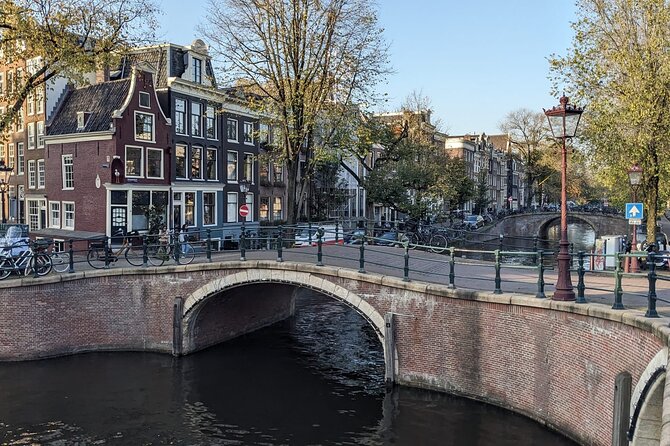
At the House on the Three Canals, you get one of Amsterdam’s most charming “how did they do that?” visuals. The guide shows you a house that sits on three canals, and then explains the bicycle bridge connection. Even if you do not picture the crossing at first, the explanation makes the whole canal layout start to click.
This stop is short, about 15 minutes, but it works because the place is so specific. Amsterdam has plenty of canal houses, but this one is a geometry lesson. It teaches you to read the city as built infrastructure, not just a view.
What you should watch for: canal-side details. Look at how the building sits relative to water and walkways. The guide’s explanation helps you see function, not just charm.
Nieuwmarkt, the Waag, guild power, and dancing houses
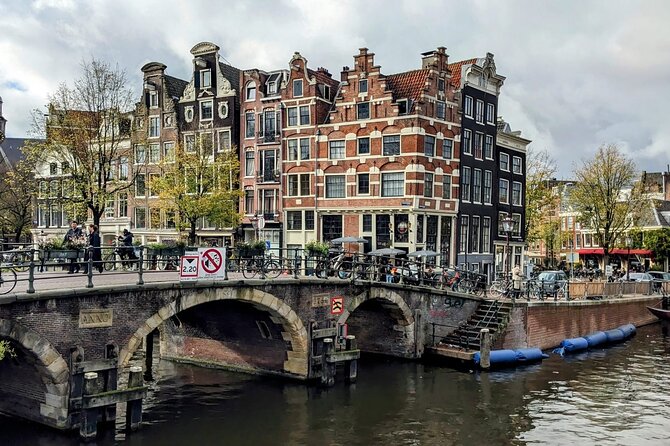
Nieuwmarkt brings you to another kind of Amsterdam story: the power of organized trade and craft. You will discover the Waag, an old city gate that later became a guild hall. That shift matters because it shows how a city repurposed its defenses and access points as commerce and regulation grew.
The tour also covers why guilds mattered in Amsterdam. This is not a vague social history lecture. You will get the practical sense that guilds shaped who worked where, how rules were set, and how skills earned status. When you understand that, the streets feel less random and more like an operating system.
Then the guide points out the dancing houses. Even if you do not know the architectural term, you will recognize the playful, uneven facade shapes that make the area famous.
Time on this stop: about 30 minutes, the longest on the route. That extra time signals that you will be absorbing more than one story here, and it is usually where questions pop up.
Zeedijk and Chinatown, from danger in the 1970s to a favorite street now
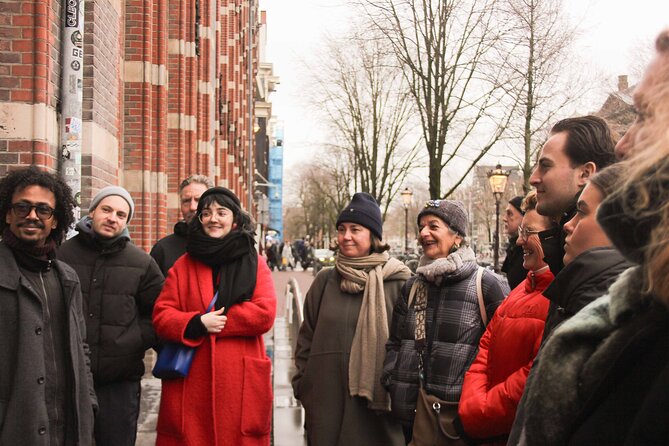
Zeedijk is where the walk gets modern and real. You learn about Chinatown on this street and hear how it was once considered the most dangerous place in Amsterdam during the 1970s. Then you hear what happened afterward as the area declined in that reputation and became a favorite spot for many Amsterdammers.
I like that the tour does not treat neighborhood change as a clean timeline. It frames it as a shift in how the area was used and perceived, which is exactly how city districts tend to evolve. You get a sense of Amsterdam as a place that changes in visible ways, not just a place that stayed frozen in time.
This is a 15 minute stop. It is enough time to place the story on the map in your head, and then keep moving without turning it into a lecture.
Centraal Station, architecture plus centuries of connection
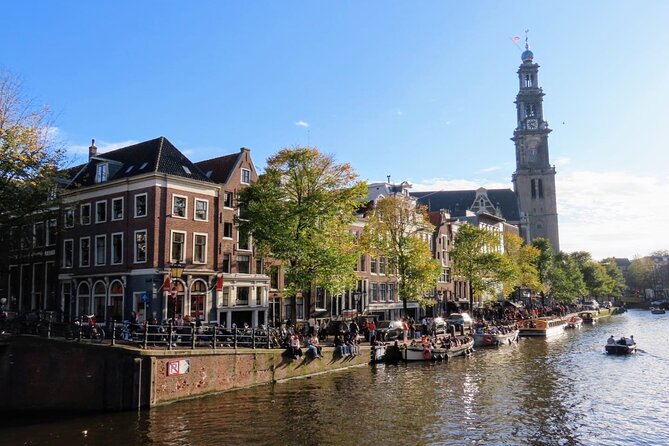
You end at Centraal Station, and it is a strong finish. The building is known for its impressive architecture, but the guide focuses on why the station location mattered long before today’s tourists arrived. You will learn that Centraal has played a crucial role for centuries as a transportation hub and a historical symbol of connection and prosperity.
That last part is useful for your future walking. After the tour, it is easy to look at Amsterdam like a chain of neighborhoods. This stop helps you see a second layer: the city’s big movement corridors. When you understand that, you start planning your own routes more intuitively.
Time: about 15 minutes. It is not an all-day station visit, but it gives you a clear sense of how the architecture and the city’s movement history tie together.
Price and what you get for $180.62 per group
At $180.62 per group, for up to 12 people, this is priced like a value-friendly private experience. The key detail is that the price is per group, not per person, so the math changes depending on how many of you are walking together. If you are traveling as a couple or a small family, it is often a good way to avoid the “one-size-fits-all” feeling of larger shared tours.
Duration also supports the value. You get roughly 2 hours, with some tours running up to 2.5 hours depending on pace and questions. For that time, you cover seven major stops that span major themes: trade and city origin, political space, religious tolerance, canal-era design quirks, guild craft power, neighborhood change, and transportation identity.
English matters too. Being offered in English means you can follow the narrative without gaps. And the mobile ticket helps you avoid last-minute paper hunting.
A practical caution: you will walk. This is not a sit-down tour. If your group prefers a lot of time indoors, you might feel like some stories pass by quickly, even though the stops are timed for comfortable pacing.
How the tour feels on the ground, and why Manouk’s approach matters
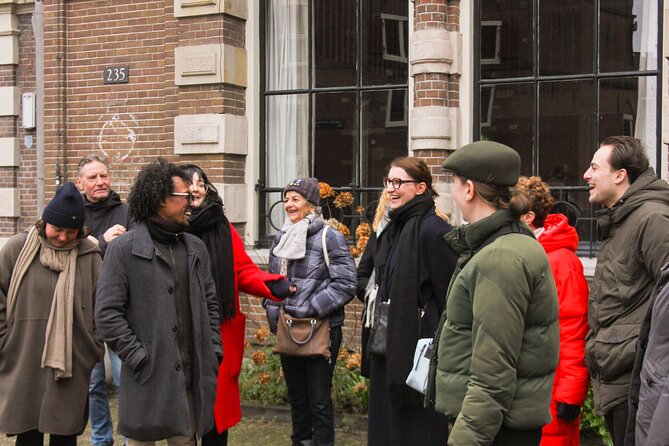
This experience is private, meaning only your group participates. That changes the vibe right away. Instead of following someone else’s momentum, you can ask questions, request clarity, and steer the conversation slightly, especially around history and architecture.
The guide, Manouk, comes through clearly in the kind of small touches that make a walking tour memorable. People mention her friendliness and the way she makes solo travelers feel comfortable, so the tour does not turn into a formal Q and A. They also mention that she prepares maps and pictures that support what she is saying, which helps you keep the big ideas organized while you walk.
One more thing that I think is worth planning for: extra local suggestions. In past experiences, she has shared food-related tips and even small edible treats. Those details might vary by day, but the overall pattern is consistent: you leave with a better sense of where to eat and what to notice next.
Who this Amsterdam walk is best for
I think this tour works especially well if you want your Amsterdam to feel connected. If you like seeing how different eras overlap, from 17th-century growth to WWII memory to neighborhood change in the 1970s, this route gives you that thread.
It also fits groups that want flexibility. The private format helps if you care more about architecture than museums, or if you want the guide to answer specific questions as you go.
If you are traveling with kids, you will still be walking a lot, but the stop lengths are short and varied. It can be a good structure for keeping attention, as long as your group is okay with outdoor pacing.
Should you book this private Amsterdam walking experience?
If you want a clear, story-driven way to understand Amsterdam without cramming into too many separate tickets, I would book it. The route hits big names and meaningful places, and the guide’s style makes it easier to remember what you saw because it connects to the city’s logic, not just its highlights.
I would skip it only if you strongly prefer indoor attractions or long sitting time. This is a walking tour with mostly outdoor viewing. If your priority is “maximum buildings per hour,” the timings might feel a bit relaxed, but that is also what makes it easier to absorb.
For most people, especially couples, friends, and families who want a local voice and a practical way to orient themselves fast, this private walk is a solid choice.
FAQ
How long is the Amsterdam private city walking experience?
It lasts about 2 hours, with some tours running around 2 to 2.5 hours depending on pace and how the walk goes.
What does it cost and what is the group size?
The price is $180.62 per group, and the tour accommodates up to 12 people per group.
Where do we meet, and where does the tour end?
You start at Beursplein, 1012 JW Amsterdam, Netherlands. The tour ends back at the meeting point.
Is this tour private?
Yes. It is a private tour, and only your group participates.
What language is it in, and do I get a ticket on my phone?
The tour is offered in English, and you receive a mobile ticket.
Is there free cancellation, and are service animals allowed?
Free cancellation is available, with a full refund if you cancel at least 24 hours before the experience starts. Service animals are allowed, and the meeting area is near public transportation.
More City Tours in Amsterdam





Amsterdam on Foot






More Tour Reviews in Amsterdam




Newly reviewed around Amsterdam



Walking Tours, side by side.
 ★ 5.0Anne Frank’s Story – Guided Walking Tour through AmsterdamFrom $3911,619 reviews
 ★ 4.8Life of Anne Frank and World War II Walking TourFrom $3710,467 reviews
 ★ 5.0Absolutely Amsterdam – the Essential Introductory Walking TourFrom $53,629 reviews
 ★ 4.8Anne Frank Guided Small Group Walking TourFrom $282,722 reviews
 ★ 4.9Anne Frank Walking Tour – Guided in EN/DE/IT/ESFrom $282,676 reviews
 ★ 4.9Guided Cultural Walking TourFrom $292,384 reviews
 ★ 4.2Guided Ganja Walking Tour of Coffee ShopsFrom $272,092 reviews
 ★ 5.0Anne Frank Walking Tour Amsterdam Including Jewish Cultural QuarterFrom $751,879 reviews
More ways to plan this visit