
REVIEW · WALKING TOURS
Amsterdam City Center Guided Walking Tour Semi-Private 12ppl Max
Amsterdam clicks into place on this 2.5-hour walk. This semi-private Amsterdam city center guided walking tour strings together major landmarks on foot, with lots of short stops for photos, questions, and context you can actually use after. It is built for people who want the big sights without getting swallowed by a giant group.
I especially like the small group size (never more than 12), because it makes the guide’s pace feel human. I also like the way you keep stopping, so you get both views and explanations, then you leave with tailored ideas for what to do next in Amsterdam. Guides such as Josje B and Hanneke are noted for very in-depth, local-feeling storytelling that helps the city make sense.
One consideration: it is a brisk walk with many quick look-and-learn moments. Also, because of security rules at some attractions, you may not be able to go inside, so if you want long ticketed visits, you will need to plan those separately.
Key things I think you’ll notice fast
- Max 12-person group means more conversation time and less rushing
- Rain or shine keeps your day on track, but you should pack for weather
- A highlight-heavy route covers both canal classics and quieter corners
- Some entrances cost extra and some stops are view-only
- Local-guide storytelling can make the city’s history feel practical, not just dates
Amsterdam at street level, a few more routes
Price and timing: is $59.28 worth 2.5 hours of walking?
At $59.28 per person for about 2 hours 30 minutes, this tour sits in the midrange for a guided walk. The value comes from two things: you get a lot of ground covered in the city center, and you get a guide who helps you understand what you are seeing as you move.
What you should expect for your money:
- A professional guide guiding the pace and the route
- Frequent stops for photos on foot, not just a drive-by “look and go”
- A format that stays small, max 12, which matters in a compact city like Amsterdam
Also, this tour is commonly booked about 51 days in advance on average. If you are traveling during a busy time, it is smart to lock it in early so you are not forced into an awkward schedule later.
The small-group promise: how “semi-private” feels in Amsterdam
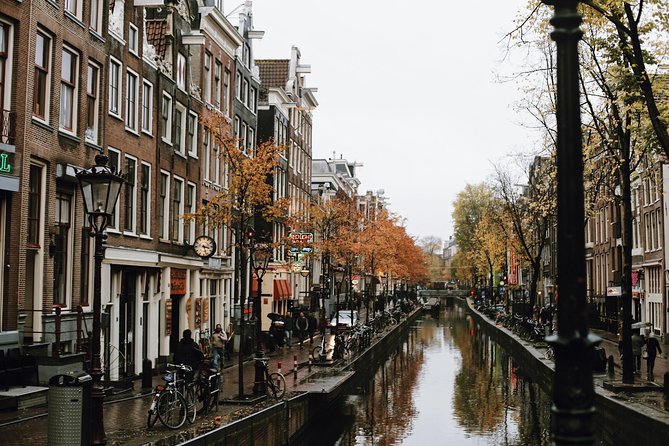
Semi-private here really means the group cap is 12. That is important because Amsterdam’s streets can feel tight, especially around canals, bridges, and popular squares. In a big group, you spend time playing catch-up. In a smaller group, you can actually ask follow-ups and hear the guide’s answers without shouting.
It is also a tour that runs rain or shine. That changes how you pack. Bring an umbrella if you have one, wear shoes that handle slick cobblestones, and plan to keep moving even when the weather turns.
One more practical note: you are expected to have a moderate fitness level. The route includes cobblestone lanes and multiple bridges, so it is not the kind of stroll where you can stop every five minutes to rest.
St. Nicholas Basilica: Roman Catholic roots in a changing city
You start at the Basilica of Saint Nicholas on Prins Hendrikkade. This is a Roman Catholic church that was built in the late 19th century after centuries when Roman Catholic worship faced prohibition. The result is a striking blend of architectural styles that mirrors how Amsterdam’s religious life changed over time.
Why this stop is useful:
- It gives you a clear starting point for understanding Amsterdam as more than canals and paintings
- Even if you do not go inside long, you get the story behind the building and the city’s shifting identity
- The listed admission ticket is free at this stop, and the time is about 10 minutes
If you like your sightseeing with a little context, this opening sets the tone for the whole walk.
Worth comparing with this Amsterdam choice:
- Amsterdam: 75 Minute City Canal Cruise with Audio Guide★ 4.4 · 17,501 reviews
- Anne Frank’s Story – Guided Walking Tour through Amsterdam★ 5.0 · 11,619 reviews
- Amsterdam: Johan Cruijff ArenA Tour with Optional Guide★ 4.6 · 8,954 reviews
- Amsterdam: Royal Palace Entry Ticket and Audio Guide★ 4.6 · 6,475 reviews
Schreierstoren, the Tower of Tears: a farewell story tied to the sea
Next comes the Schreierstoren, also called the Tower of Tears. This medieval structure is remembered for the moment women bid farewell to loved ones departing by ship.
What I like about this kind of stop is that it links a specific landmark to a human event. You are not just looking at old stone, you are understanding why people would stand there and feel something.
This stop is about 10 minutes, and the admission ticket is not included.
Zeedijk and the Kolksluis: Amsterdam’s old sea-defense lines
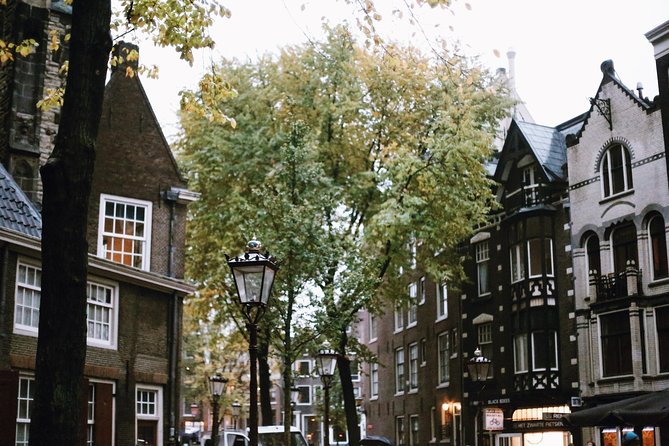
Zeedijk is one of Amsterdam’s oldest streets. Here, the guide connects the dots between geography and history by explaining how Zeedijk used to function as a sea dike holding back the waters of the IJ. Then you reach the Kolksluis, where you can admire one of the city’s picturesque lock bridges.
This part is great for:
- Photo time, because the scenery is both historic and visually interesting
- Learning the practical reason Amsterdam’s city layout makes sense, especially around water control and crossings
- Building a mental map before you move into the busier squares later
Time here is about 10 minutes, and admission is listed as free.
Nieuwmarkt and De Waag: the trading square and the city gate that became many things
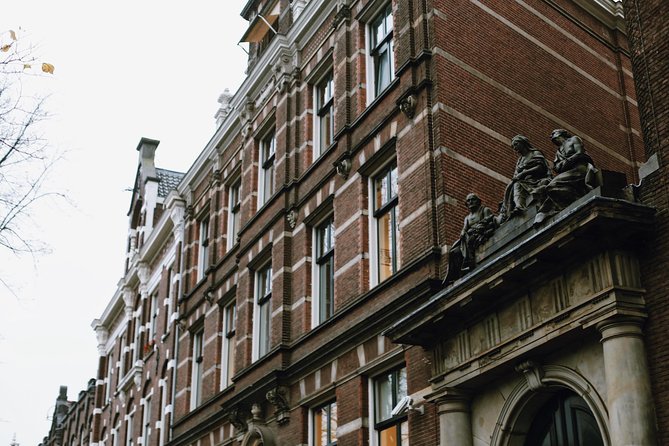
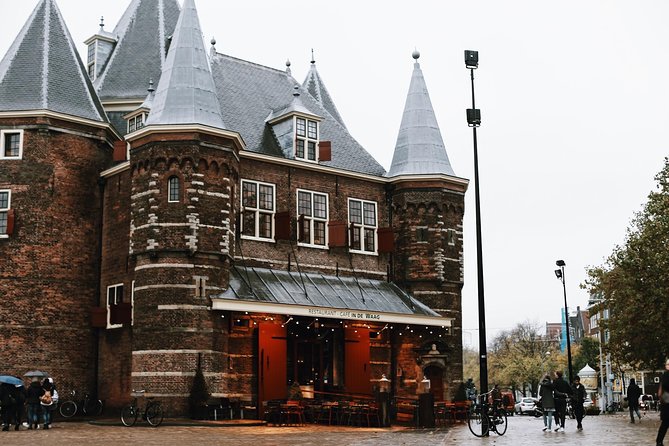
At Nieuwmarkt, you step into the old city center nightspot and market square. The key idea is that it has been a commerce and social meeting place since the 17th century. The square’s position just inside the old city gate made it natural for traders and shoppers moving through town.
From there you see De Waag, a 15th-century building that is one of Amsterdam’s oldest remaining non-religious buildings. It started as a city gate and part of the walls, then later served multiple roles, including a guildhall, museum, and even a fire station.
Two reasons this stop works well on a walking tour:
- You see a whole neighborhood story in a compact area
- You learn how buildings here were repurposed as the city changed
Both stops are listed as free, with about 5 minutes each.
Trippenhuis and Klein Trippenhuis: wide versus narrow, and why it happened
Next you spot Trippenhuis and Klein Trippenhuis close together. The Trippenhuis is described as Amsterdam’s widest home, spanning about 22 meters. Across from it, Klein Trippenhuis is one of the narrowest houses in the city.
The small but clever lesson here is about land taxes. The explanation you get ties the city’s architecture to policy and economics: higher taxes on land encouraged taller, narrower homes.
This section is short, about 5 minutes for each, and the admission ticket is not included. Treat it as a look-up-and-notice moment: notice proportions, façades, and the contrast between neighboring buildings.
Oost-Indisch Huis courtyard: the East India Company and early globalization
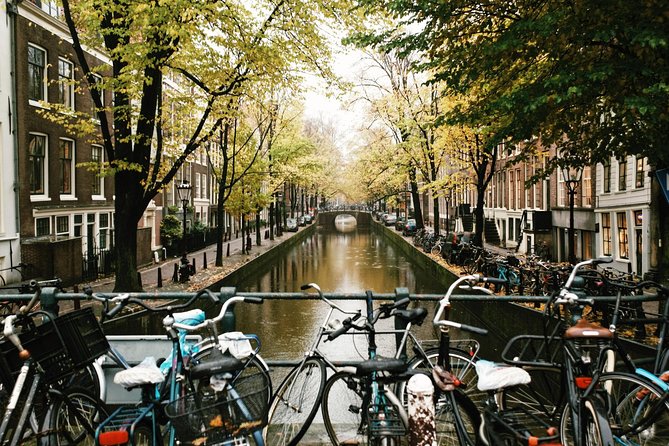
You also reach the Oost-Indisch Huis, stepping into the courtyard of the Dutch East India Company’s headquarters. It is described as the birthplace of the world’s first multinational corporation.
Even if you only pause briefly, this stop gives you a big-picture anchor for Amsterdam’s wealth. It connects the city’s merchant power to real places and real institutional beginnings.
Admission is listed as not included here, and time is about 5 minutes.
Zuiderkerk, Rembrandt’s orbit, and the Stopera: religion, art, and civic life
After the canal and corporate energy, the route turns toward religious and cultural landmarks.
- Zuiderkerk is Amsterdam’s first purpose-built Protestant church, designed by Hendrick de Keyser, with an elegant tower that is a defining landmark. This stop is about 5 minutes, and admission is not included.
- You then pass by the Museum Het Rembrandthuis, the historical building where Rembrandt lived and worked between 1639 and 1656. The museum holds Rembrandt’s etchings and works by his contemporaries. This is also about 5 minutes and not listed as included for admission.
- Next is the Stopera, the complex that houses both the city hall and the Dutch National Opera and Ballet. Construction took at least 60 years. Again, about 5 minutes with admission not included.
Why I think this cluster matters: you get a sense of how Amsterdam’s power shows up in different ways. Some of it is belief, some is art, and some is civic identity all in one corridor.
Huis Aan De Drie Grachten and Begijnhof: when canals go quiet
Huis Aan De Drie Grachten is a rare 17th-century canal house located at the junction of three canals, with façades facing in three directions. It is a short stop, but it is exactly the kind of building that makes you look twice. You start noticing canal geography as a design challenge, not just scenery.
Then you reach Begijnhof, one of the oldest hofjes, which are almshouses in Amsterdam. The story is specific: it consists of houses built around a secluded courtyard and garden, historically providing homes for the Beguines, unmarried women who lived together under vows of chastity. Today, the site includes two churches.
This is about 5 minutes, admission not included. It is not the kind of stop where you need tickets to get something out of it. Even a quick look helps you understand why Amsterdam can feel both public and private, depending on where you stand.
Dam Square and Herengracht Golden Bend: the royal center and the richest canal stretch
Dam Square is a major finale-style stop in the city center. It includes the Royal Place, New Church, and the National Monument. It is described as one of the best-known areas because of frequent events and the big-name architecture nearby. Time here is about 5 minutes and admission is listed as free.
From there you see Herengracht, especially the Golden Bend lined with some of the city’s richest and most ornate canal mansions from the Dutch Golden Age. Time is about 5 minutes and admission is free.
If you only have a short time in Amsterdam, this part helps you grasp the city’s status symbols. You see how wealth, architecture, and water routes were connected.
Outside Anne Frank House, then De Drie Hendricken: two very different kinds of remembrance
You pause outside the Anne Frank House, where she hid during World War II. Next door is the Westerkerk, noted as having the tallest church tower in Amsterdam.
This stop is about 5 minutes, admission not included. You are not there for a long guided visit, so it is best if you already know what you want to do later. If you want a deeper Anne Frank House visit with tickets, plan it as a separate activity.
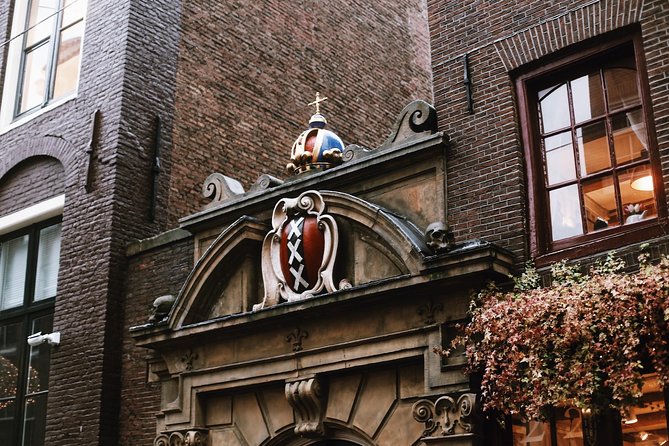
Then you look up at De Drie Hendricken aan de Bloemgracht 87-91. The guide points out quirky gable stones with allegories and trade emblems, decorating ornate façades. This is one of those details you could miss if you were walking alone, and it is free with about 5 minutes allocated.
Rembrandtplein and Noorderkerk: art celebrations and Reform-era design
Rembrandtplein is next, tied to Rembrandt and his cultural footprint in Amsterdam. You see a bronze-cast representation of The Night Watch, linked to the 400th birthday celebration in 2006.
Admission is listed as free and time is about 5 minutes.
Then you reach Noorderkerk, a 17th-century Protestant church built for the Jordaan district. The distinctive part here is the cross-shaped floor plan, connected to new ideals of Reformation worship. Time is about 5 minutes, admission not included.
This section balances modern art fame with older religious architecture. It is a good reminder that Amsterdam’s identity keeps shifting, even when buildings remain.
Papeneiland: the end spot that feels like a reward
The tour ends at Het Papeneiland, a brown café from 1642 at a pretty canal corner on Prinsengracht. It is said to serve what is claimed to be the best apple pie in town.
The tour time here is about 5 minutes and admission is listed as free. Think of it as a walking-tour cool down. You finish, catch your breath, and you have a logical place to grab a snack or a drink while you plan what to do next.
Before you go: what to bring and what to expect from inside access
This is a walk, so pack for walking. The tour notes suggest:
- Comfortable shoes for cobblestones
- A bottle of water
- An umbrella if rain is likely
- A hat during summer
They also note that some attractions cannot be visited from the inside due to security measures. So treat this as a landmark spotting and story-telling tour, then use your remaining time for ticketed museum visits or longer church visits if you want that level of access.
If you travel with large bags or suitcases, note that large items are not allowed on this tour.
Who this tour suits best, and who might want a different plan
This experience fits best if you:
- Want lots of Amsterdam highlights in one morning or afternoon block
- Like your sightseeing with explanations you can use later when you explore on your own
- Prefer smaller groups for questions and photo stops
- Have moderate walking stamina for bridges and cobblestones
You might want another option if you need wheelchair access or have walking disabilities, because the tour is not recommended for those using a wheelchair.
It is also worth knowing that confirmations happen at booking, and the tour needs a minimum number of travelers to run. If it cannot run, you will be offered another date or a full refund.
Should you book this Amsterdam city center guided walking tour?
Yes, if your goal is to get your bearings fast and understand what you are seeing across the city center. The highlight mix is strong, from religious landmarks like St. Nicholas Basilica and Zuiderkerk, to trading history at Nieuwmarkt and De Waag, to quiet-feeling Begijnhof, to the grand civic canvas of Dam Square and Herengracht.
I would book it when:
- You only have a limited number of hours for guided sightseeing
- You want the small-group advantage and more personal guiding
- You like photo stops and short, story-driven moments rather than long museum sessions
I would pass or pair it carefully if:
- You want to spend lots of time inside major ticketed attractions during the tour itself
- You need an itinerary designed around limited walking
- You are traveling with bulky luggage that you cannot leave elsewhere
If you do book, wear good shoes, bring weather protection, and come ready to look up as much as forward. That is where the city’s details make the biggest difference.
FAQ
How many people are on the tour?
The tour is semi-private with a maximum group size of 12 travelers.
How long is the Amsterdam city center walking tour?
It runs for about 2.5 hours (2 hours 30 minutes approx.).
Does the tour run in bad weather?
Yes. The tour will run rain or shine.
Are admission tickets included for the stops?
Admission is not consistently included. St. Nicholas Basilica is listed as free, while some stops such as the Weeping Tower are not included, and several other stops are also listed as not included.
Is the tour suitable for wheelchair users or limited mobility?
It is not recommended for those with walking disabilities or using a wheelchair.
Can I get a full refund if I cancel?
Yes. You can cancel up to 24 hours in advance for a full refund. If you cancel less than 24 hours before the start time, the amount you paid is not refunded.
Amsterdam on Foot






More Tours in Amsterdam




More Tour Reviews in Amsterdam






Newly reviewed around Amsterdam





Walking Tours, side by side.
 ★ 5.0Anne Frank’s Story – Guided Walking Tour through AmsterdamFrom $3911,619 reviews
 ★ 4.8Life of Anne Frank and World War II Walking TourFrom $3710,467 reviews
 ★ 5.0Absolutely Amsterdam – the Essential Introductory Walking TourFrom $53,629 reviews
 ★ 4.8Anne Frank Guided Small Group Walking TourFrom $282,722 reviews
 ★ 4.9Anne Frank Walking Tour – Guided in EN/DE/IT/ESFrom $282,676 reviews
 ★ 4.9Guided Cultural Walking TourFrom $292,384 reviews
 ★ 4.2Guided Ganja Walking Tour of Coffee ShopsFrom $272,092 reviews
 ★ 5.0Anne Frank Walking Tour Amsterdam Including Jewish Cultural QuarterFrom $751,879 reviews
More ways to plan this visit