
REVIEW · AMSTERDAM CITY TOURS
Amsterdam Pedicab City Tour (2 hours)
A two-hour pedicab tour can change your Amsterdam mindset fast. This one is built for big sights with low walking, plus the kind of local context that helps the city make sense from the start. I love that the route stitches together old center landmarks and quieter neighborhoods without you feeling like you are trapped in a bus schedule. One possible drawback: most stops are short, so if you want long museum time, you will still need separate tickets.
What makes it work is the private setup and the way Bram de Haan talks about what you are actually passing. I especially like the photo-and-map style of storytelling, where older Amsterdam is compared to what you see today, and you get frequent chances to pull over for pictures. The only real consideration is comfort planning, because you will be out on the street for the full ride, and the operator notes the experience depends on good weather.
If your goal is to get oriented quickly and see a cross-section of Amsterdam, this pedicab tour is a strong choice. You will roll past squares, canals, bridges, and major Jewish sites, then finish near the museum district. Just keep your expectations aligned with a guided drive with quick stops, not a slow, deep museum day.
Key Things That Make This Pedicab Tour Feel Special
- Private ride up to 2 people, so the pace and photo stops can match your interests
- Bram de Haan’s photo and map comparisons, which help you picture Amsterdam’s growth over time
- Short, efficient sightseeing stops, covering Dam Square, the Jewish quarter, canal ring, and Museumplein in one loop
- Comfort for real-world weather, including waterproof coverings and warm blankets mentioned by past guests
- Canal views without the calf burn, since you cover more ground on two wheels
Wider sweeps of Amsterdam, compared by pace
Private Pedicab Orientation: How the 2 Hours Actually Feel
Amsterdam can be a lot in a first day. Streets twist, canals branch, and every block seems to have a story. This tour helps because you glide above the traffic rhythm instead of weaving through it on foot, and you get a local guide focused on your side of the map.
The pedicab setup also means you spend your energy where it matters: looking, taking photos, and asking questions. You will likely be out of the seat only briefly at key points, so even if the city is busy around you, you are not getting swallowed by crowds for long stretches.
One detail I like for practical travelers: the stops are timed like checkpoints. Dam Square is just a quick orientation moment, while other spots are slightly longer for photos and street-level context. That structure keeps the tour from turning into a slow shuffle, but you still get enough time to absorb what you are seeing.
Price and Value at $237.65 Per Group (Up to 2)
The price is listed as $237.65 per group, up to 2 people, for about 2 hours. If you fill both seats, that works out to roughly $119 per person, which is the easiest way to judge value.
Here is what you are really paying for: private transportation plus a guide who adjusts pace and attention around you. In a city where group tours can move at one speed for everyone, paying for a private pedicab often saves time and energy, especially if you are jet-lagged, traveling with older family members, or just want the first-day win of being properly oriented.
What might make it feel pricey is if you are solo. With the pricing set per group, you may end up paying the full group amount even if only one seat is used. If you are traveling as a couple, two friends, or a family unit, it tends to feel more balanced.
Pickup at Your Hotel and the Blue Pedicab System
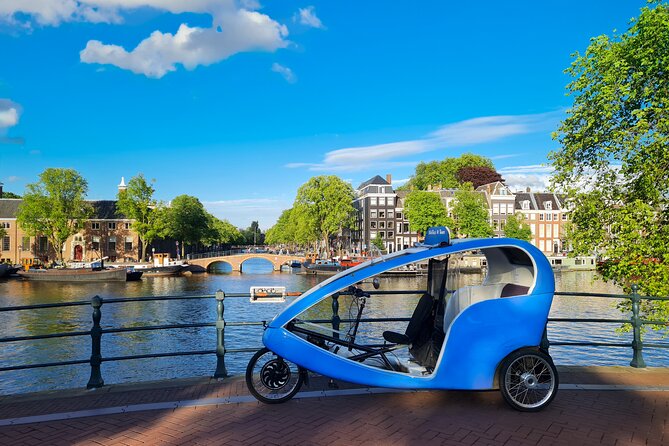
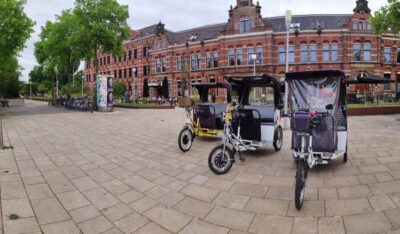
Pickup is offered. The plan is simple: wait in front of your hotel and look for the blue pedicab. That matters because Amsterdam hotels can be in busy lanes, and having a clear pickup method reduces the usual early-day stress.
You also get a mobile ticket. In practice, this helps you spend less time on paperwork and more time at curbside, where the tour staff can quickly match your group.
This is also described as near public transportation. So if you are not staying in a super-central area, you should still be able to coordinate with the pickup plan without complicated transfers.
Worth comparing with this Amsterdam choice:
- Amsterdam: 75 Minute City Canal Cruise with Audio Guide★ 4.4 · 17,501 reviews
- Amsterdam: City Centre Canal Cruise★ 4.2 · 12,827 reviews
- Amsterdam: Smoke and Lounge City Boat Cruise★ 4.7 · 8,572 reviews
- Amsterdam: Guided Bike Tour City Centre in EN/DE/FR/ES★ 4.7 · 4,187 reviews
Dam Square, Zeedijk, and Chinatown: The Old Center in One Swipe

Your first big landmark is Dam Square, Amsterdam’s central square and the heart of the old city core. From here, you get a natural “start line” for everything that follows, including the Royal Palace area, the New Church, and the National Monument. Even if you have seen photos, the scale feels different when you are standing there, then immediately rolling out again instead of getting stuck in a long walk.
Next is Zeedijk, one of the oldest dike lines around the old center. The area is known for an old-school Amsterdam café atmosphere with original interiors, but the guide also promises a darker story tied to the neighborhood. You should expect a narrative shift here: pretty street scenes first, then the kind of history that makes you look twice at everyday facades.
Then you slide into Chinatown, described as the oldest Chinese neighborhood on the European mainland. What makes this stop useful is that it is not just food and shops. You also get context that it includes places like a Chinese temple, so the area feels lived-in and cultural, not only commercial.
Practical note: these early stops are short, so treat them as orientation and photography checkpoints rather than deep sightseeing. If you want to linger in Chinatown, the tour sets up your next self-guided wander.
Nieuwmarkt and Montelbaanstoren: City Gates, Defense Lines, and Canal Drama
At Nieuwmarkt, the tone turns from squares and streets to structure and power. The square is tied to the old city gate concept, when Amsterdam was walled and fortified before major 17th-century expansion. If you like understanding why cities are shaped the way they are, this is one of the more satisfying stops because it connects geography with history.
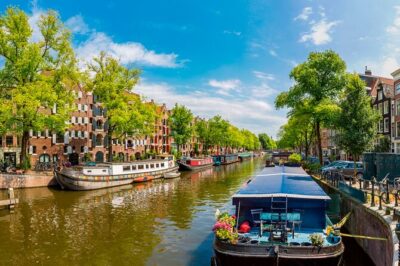
Then comes Montelbaanstoren, an early 16th-century watch tower linked to the city’s defense line. It also gives you one of the more “Amsterdam in a sentence” views: the lookout over de Oude Waal with houseboats lined up against the backdrop of classic canal houses.
Even if you are not the type to read every plaque, this is where the pedicab format shines. You get a meaningful viewpoint without the effort of a long walk across multiple bridges. You also get that quick wow factor, where the canals and boats feel organized, almost staged, even though they are real neighborhoods.
Rembrandt House Outside View and the Jewish Quarter Flow
Your tour includes the Rembrandt House Museum area, but it is an outside look. Entering the museum is possible, it just is not included in this tour. I like this approach because it keeps the 2-hour focus on movement and context, while still giving you a recognizable landmark connected to one of the city’s most famous artists.
After that, you shift into Jodenbuurt, the Jewish neighborhood area. A large portion was impacted after World War II, but some important buildings, synagogues, houses, and street patterns still exist. This is one of the stops where the guide’s narration style matters. You are not just seeing buildings. You are learning how displacement and rebuilding changed the urban fabric.
For many visitors, this portion is emotionally heavier than the early sightseeing. The value here is that it is handled as a real part of the city, not as a rushed history side quest. You will likely feel the pacing built to let the stories land.
Portuguese Synagogue and the Holocaust Names Monument: Serious Stops, Clear Context
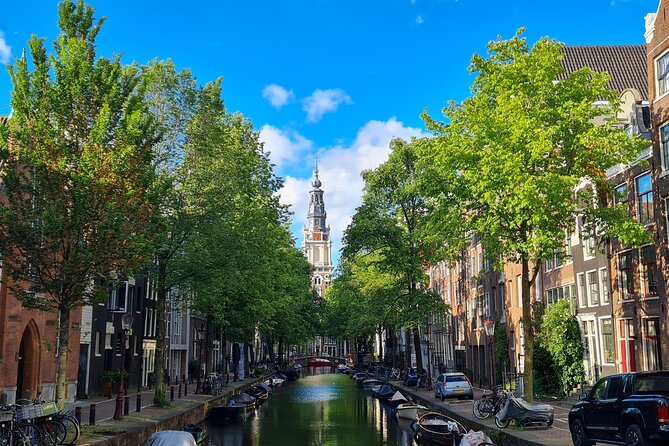
The Portuguese Synagogue of Amsterdam is one of the major anchors in this segment. It is noted as the largest synagogue and among the early Western Europe builds allowed in the late 17th century, with 1675 specifically mentioned. You will see the exterior and also what is opposite it, including other synagogues that now relate to the Jewish museum area.
This is a powerful pairing with the next stop: the National Holocaust Names Monument. It is described as having 102,000 brick stones with names, commemorating Dutch Jewish victims. Even if you only get a brief look from the pedicab route, the stop gives the trip moral weight and a clear focus on remembrance.
Because these are short segments, I suggest mentally preparing for them as brief but meaningful moments. If you want time to sit and absorb quietly, plan to do that on a separate visit. This tour’s strength is guided orientation plus respectful, well-placed passing stops.
H’ART Museum Pass-By and Magere Brug Photo Time
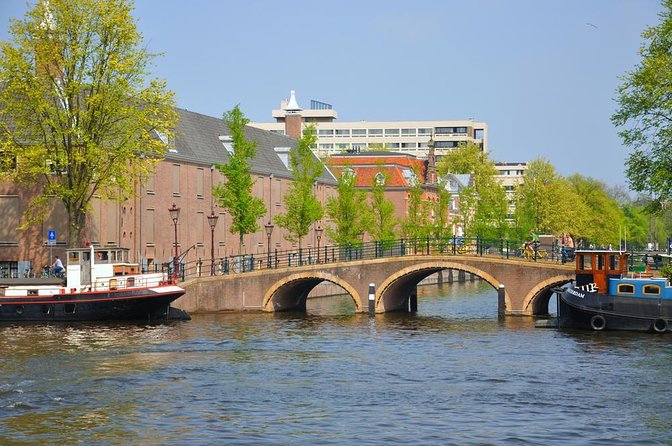
You also pass by H’ART Museum, mentioned as part of the Hermitage museum family story. The building previously served as a monumental widow house and care house dating to the 17th century, and the tour frames it as a piece of Amsterdam architecture that gained new life.
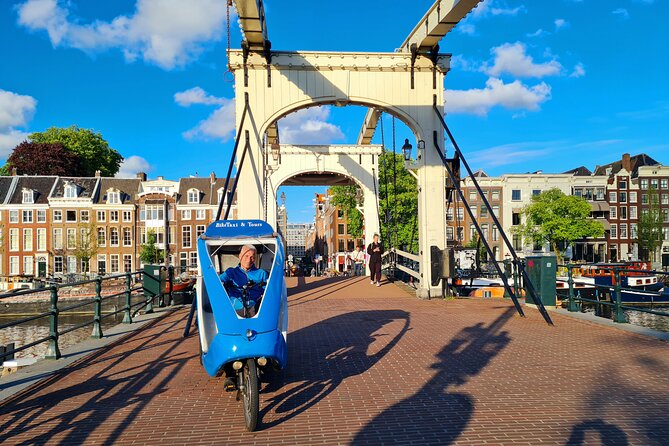
Then you head to Magere Brug, one of Amsterdam’s iconic “skinny bridges.” The key reason it earns a stop is visibility. From here, you get a wide view over the Amstel river, and the bridge is known for lighting effects at night with bulbs accentuating its slender design. Even during daytime, it is a great place to grab a crisp canal-and-bridge photo from a single vantage.
If you like photography, this is also one of the moments where the pedicab’s frequent stopping pays off. You do not need to fight for position on a crowded walkway for long. You simply arrive, look, shoot, and move on.
Canal Ring (Grachtengordel) and Museumplein: The Big Finish With Views
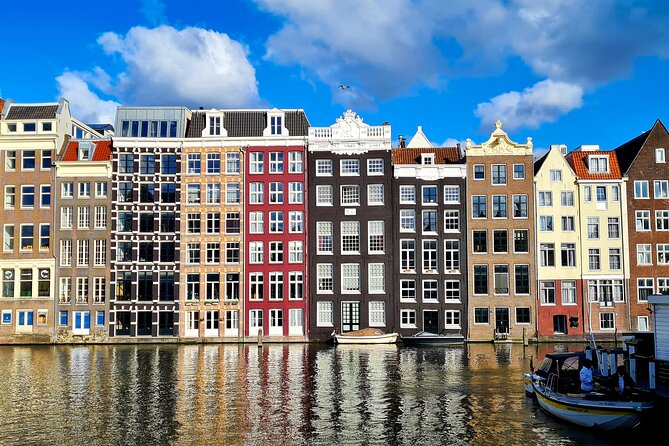
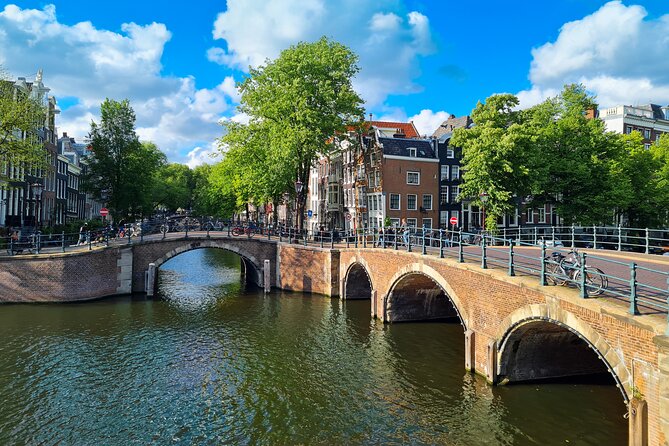
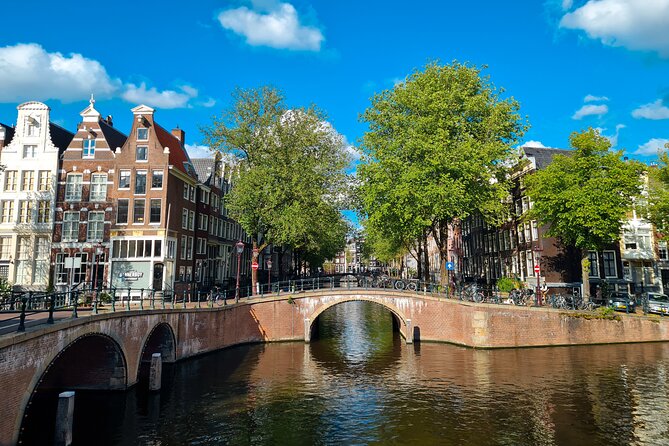
The Canal Ring, Grachtengordel, is where the tour shifts into Amsterdam’s signature postcard logic. The ring is described as the 17th-century expansion area, visible as half circles around the old center. You will see the typical canal house look, but with an important nuance: even though the houses share familiar traits, each one is slightly different, and those differences reveal the building era.
This is a stop that rewards attention. If you spend a minute really looking at canal houses, window rhythms, and facade patterns, you can start to understand why people fall for Amsterdam even after the first day. The guide narration helps connect what you see to why it exists.
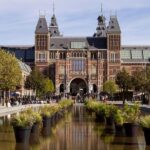
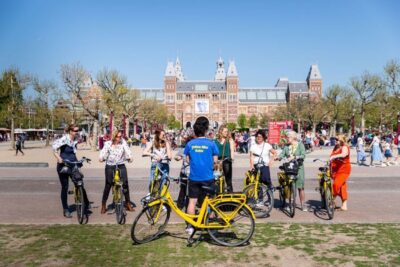
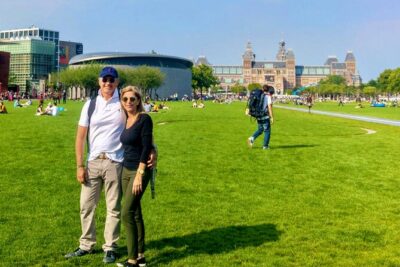
Finally, you reach Museumplein, a big square built for the museum district universe. The tour highlights Rijksmuseum and the Concertgebouw across from each other, and it also points out nearby major names like Van Gogh Museum, Stedelijk Museum, Moco Museum, and the Diamond museum. Even if you do not go inside, the area gives you a sense of what Amsterdam prioritizes culturally.
One last practical highlight ties everything together: you pass through the famous bicycle tunnel under the Rijksmuseum, where street musicians and classical music can sometimes be heard. Then you roll toward a great view of the back of the museum, completed in 1885 and designed by Pierre Cuypers. That combination, tunnel moment plus a landmark view, makes a strong ending because it feels distinctly Amsterdam and distinctly specific.
Weather Reality: Rain Gear and Cold-Weather Comfort
This experience requires good weather. That is not just a legal note, it changes how comfortable you are for the full ride. If the forecast is stormy, expect a reschedule or refund offer, depending on what the operator can do.
The good news is that comfort gear comes up in past experiences. One specific detail mentioned is a waterproof blanket used during rainy moments, and blankets provided for cold conditions in the winter season. Plan to dress for wind as well as temperature, because canals and open squares can feel cooler than you expect.
Practical tip: wear shoes you can step into quickly at photo stops. Even short get-out moments add up across 2 hours.
Who Should Book This Pedicab Tour
This tour fits best if you want:
- A first-day orientation that hits major landmarks plus meaningful neighborhoods
- To see a lot without draining yourself with long walks
- A private guide who answers questions and pulls over when you want photos
- A partner or small group traveling together, since it is priced for up to 2
It might not be your best choice if:
- You want long museum time, because several key sights are outside views or quick stops
- Your priority is deep, slow historical walking tours, since the format is designed for coverage
Should You Book the Amsterdam Pedicab City Tour?
I would book it if your goal is to get your bearings fast, then spend the rest of your trip exploring with better context. The strongest part is the pairing of efficient route coverage with guide storytelling that includes maps and older photos, plus plenty of chances to stop for pictures.
If the pricing feels tough, solve it the simple way: book with someone so you use both seats and spread the per-group cost. And if weather is questionable, keep your schedule flexible because the operator flags good weather as important.
For a couple, a small family unit, or anyone who wants an organized Amsterdam intro without the grind of constant walking, this is one of the more practical ways to see the city’s highlights in a short window.
More Tours in Amsterdam






More Tour Reviews in Amsterdam





See the City from Another Angle




Newly reviewed around Amsterdam



Amsterdam City Tours, side by side.
 ★ 4.7Relaxed City Highlights Guided Bike TourFrom $341,069 reviews
 ★ 5.0Amsterdam City Highlights and Hidden Gems – Private & Custom TourFrom $91231 reviews
 ★ 4.8Explore the City Highlights by BikeFrom $46160 reviews
 ★ 4.9Private Guided City Tour by PedicabFrom $118130 reviews
 ★ 5.0Panoramic Private City Tour in AmsterdamFrom $69385 reviews
 ★ 4.6Red Light District & City Tour German or EnglishFrom $27140 reviews
 ★ 5.02 hours Amsterdam City Tour in PedicabFrom $23939 reviews
 ★ 5.0Amsterdam Layover: Airport Transit City TourFrom $21434 reviews
More ways to plan this visit